This action will delete this post on this instance and on all federated instances, and it cannot be undone. Are you certain you want to delete this post?
#fediverse 99 hashtags



Week in Fediverse 2026-10-23
Servers
- Hubzilla v11.4.2
- TinyAP v0.2.1
- Iceshrimp v2026.5.4
- GoToSocial v0.22.3
- Wafrn v2026.10.02
- Castopod v1.15.6
- NeoDB v0.19.9.1
- Merp Relay v0.4.3
- NodeBB v4.16.4
- Loops Server v1.0.0-beta.15
- PieFed v1.8.6
- wanderer v0.21.1
- 5.0: A closer look (Mastodon)
Clients
- mlmym v26.4.1
- Summit v1.88.0
- RaccoonForFriendica v1.1.5
Tools and Plugins
For developers
-----
#WeekInFediverse #Fediverse #ActivityPub
Previous edition: https://mitra.social/objects/01a1464f-ff2a-7932-98fa-d2e25de0b63a

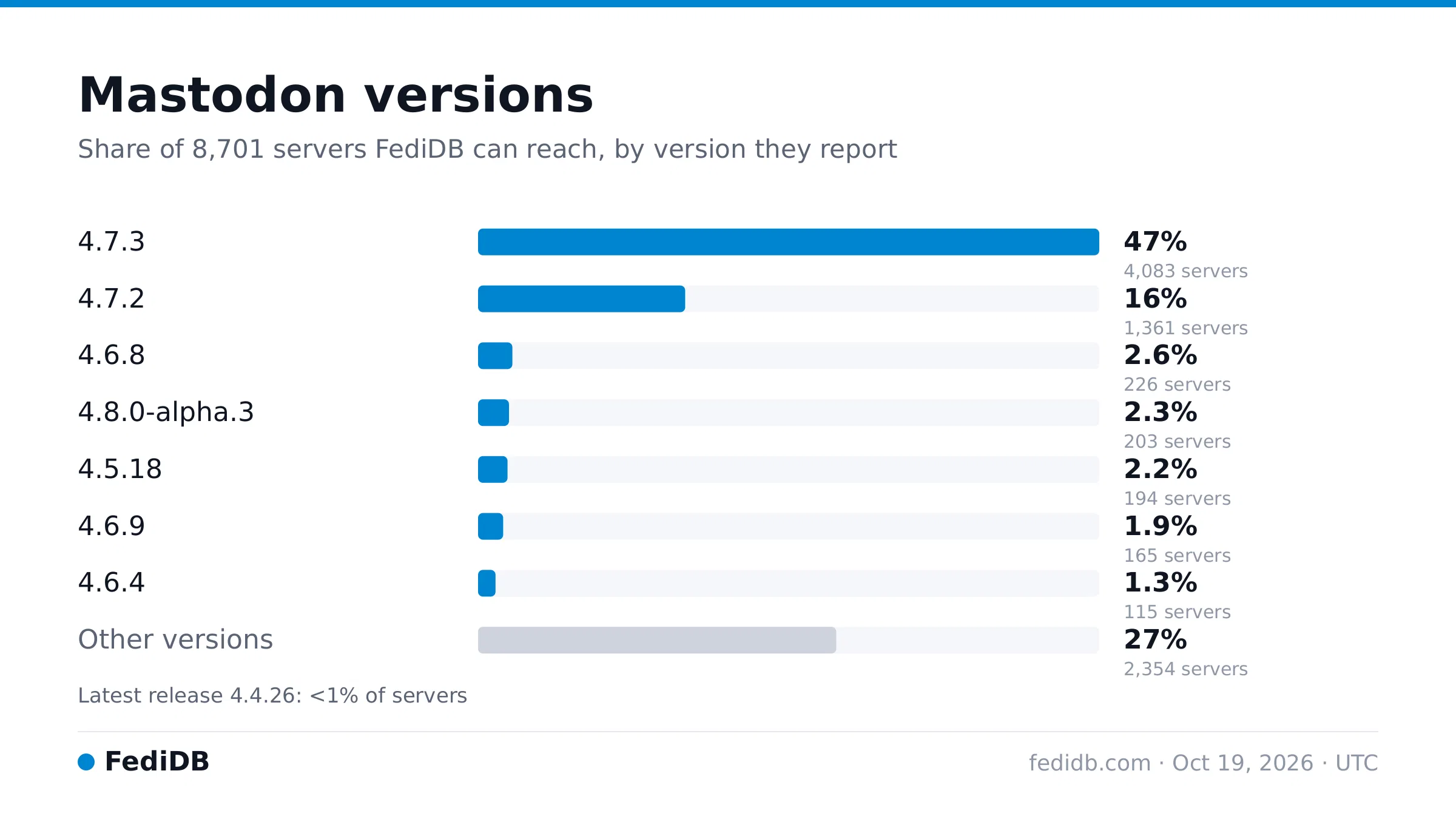
There’s a bot for that
Five new fediverse accounts that post what FediDB sees: charts of the network, new software, new large servers, release adoption and the projects growing fastest.
Week in Fediverse 2026-10-16
Servers
- GoToSocial v0.22.2
- Hollo v0.9.23
- snac v2.96
- Funkwhale v2.0.12
- Vernissage Server v1.44.0
- FitPub v1.3
- Hometown v1.3.1
- yukimochi/Activity-Relay v2.0.12
- Iceshrimp v2026.5.2
- NeoDB v0.19.8
- Forgejo v0.17.0
- NodeBB v4.16.3
- PieFed v1.8.5
Clients
- IceCubesApp v2.1.6
- Mastodon Bird UI v4.7.3-2026-10-11
- RaccoonForFriendica v1.1.3
- chan-fe v0.5.0
Tools and Plugins
- Poduptime v6.3.3
- FediFetcher v8.2.3
- Enable Mastodon Apps v1.7.0 (WordPress plugin)
For developers
Articles
- Some quick thoughts on Unit Testing ActivityPub
- Threads and the Fediverse: The Threat That Wasn’t
-----
#WeekInFediverse #Fediverse #ActivityPub
Previous edition: https://mitra.social/objects/01a12226-89dc-7182-949d-94663546af6c
Week in Fediverse 2026-10-09
Servers
- Hollo v0.9.22
- PieFed v1.8.0
- Mitra v5.11.0
- Mbin v1.11.0
- Catodon v26.10.0
- NeoDB v0.19.6.3
- NodeBB v4.16.2
- Lemmy Development Update September 2026
Clients
- Tusky v33.0
- Pachli v3.9.1
- IceCubesApp v2.1.4
- Summit v1.87.0
- Pixelfed Mobile App v2.0.0
- Aria v1.5.15
For developers
- Fedify security updates: 2.0.30, 2.1.26, 2.2.15, 2.3.10, and 2.4.0
Protocol
- FEP-4f18: ActivityPub Network Time
-----
#WeekInFediverse #Fediverse #ActivityPub
Previous edition: https://mitra.social/objects/01a0fe1a-a0fe-7d20-895a-b18c4561484c
Week in Fediverse 2026-09-25
Servers
- Pixelfed v0.14.0
- Ktistec v3.13.0
- XWiki ActivityPub Extension v1.7.12
- Misskey v2026.9.1
- NeoDB v0.19.3
Clients
- Fedilab v3.44.0
- Smither v3.6.7
- Pixelix v5.2.2
- RaccoonForFriendica v1.1.1
- Aria v1.5.14
Tools and Plugins
Protocol
Articles
- The Algorithm, Apparently Chronological
-----
#WeekInFediverse #Fediverse #ActivityPub
Previous edition: https://mitra.social/objects/01a0b604-9fbd-7213-b1c1-8084f3f2447b
Todd Sundsted posted Sep 22, 2026
Release v3.13.0 of Ktistec
Release v3.13.0 of Ktistec ("love who you choose to love") links the feed deck into the navigation. Feeds are now fully supported.
Feeds are custom collections of posts selected by hashtag, mention, and keyword, each grouped as terms you want any of, all of, or none of, so a feed can be as broad or as narrow as you like. The feed deck is my primary reading interface now.
The rest of the changes mostly address a variety of small federation issues:
Added
- Link the feed deck from the secondary nav bar.
- Offer a retry and a link when a quoted post can't be loaded.
Fixed
- Keep the verify button when a quote authorization can't be fetched.
- Verify HTTP signatures over the full set of headers the
headerssignature parameter names. - Sign an inbox delivery's fetches with the implicated account.
- Render directly published media objects as attachments.
- Handle more attachment media types when rendering.
Changed
- Finish the feeds API.
- Widen the metrics charts display.
With feeds shipped, I'm turning my attention back to federation. There are still a ton of small issues (e.g. Likes relayed through Groups are always rejected, RFC 9421 support, blurhash support) that I'd like to squash.
Todd Sundsted posted Sep 14, 2026
every so often i crank inbox logging up as loud as it will go and then spend the next two weeks fixing federation bugs. this is apparently the start of those two weeks.
fixing issues with http signatures now...
Week in Fediverse 2026-09-11
Servers
- Hubzilla v11.4.1
- Bookwyrm v0.9.3
- Cookifed v0.1.0
- Ktistec v3.12.1
- Misskey v2026.9.0
- gathio v1.6.7
- NeoDB v0.18.2
- Appy v0.7.0
- PieFed v1.7.15
- Wafrn v2026.09.01
Clients
- Voyager v2.49.0
- Miria v4.0.1
- Aria v1.5.13
Tools and Plugins
- Enable Mastodon Apps v1.6.4 (WordPress plugin)
Articles
- Static ActivityPub Publishing
-----
#WeekInFediverse #Fediverse #ActivityPub
Previous edition: https://mitra.social/objects/01a06eb0-8683-70d3-bb1d-19ef2967e02b
Todd Sundsted posted Sep 11, 2026
Release v3.12.1 of Ktistec
Release v3.12.1 patches a bug that's been present for about two years and fixes issue #163 in the process. Looking at FediDB, it appears most servers on v3.X.X made it through the upgrade to v3.5.0, which is where the bug would have bitten, but the consequences of the bug are annoying enough that a patch is warranted.
Changed
- Gather query planner statistics on startup and before reconciling materialized views.
Up-to-date query statistics ensure that the expensive migration in v3.5.0 completes in seconds or minutes, instead of hours!
Todd Sundsted posted Sep 1, 2026
Release v3.12.0 of Ktistec
This release encompasses two broad sets of changes: widening the pool of candidates for feeds and more carefully checking the origin of inbound activities (broadly FEP-fe34, Origin-based security model).
Candidates for feeds were originally limited to posts in the actor's mailboxes. This decision made authorization easy but omitted clearly acceptable posts (for example, posts addressed to the public collection) that arrived via other means (for example, filling in a thread).
Prior to this release, inbox processing did not consistently define an object's origin nor did it apply consistent rules to what it admitted based on the origin.
FEP-fe34 is still not fully enforced, and truth be told, I'm still reviewing some of its mandates, so I'm not yet listing it in Ktistec's federation documentation.
Here's the full list of changes:
Added
- Notify a deck pane when it has new posts.
Fixed
- Retry an unresolved quote authorization.
- Label a draft with the status of its quote request.
- Compare origins when deciding whether to trust an IRI, key document, or owner.
- Ignore a trailing slash when matching a dereferenced document's IRI.
- Allow only
CreateandUpdateto update objects. - Ignore an inbound vote that fails the FEP-9967 checks.
- Expand commonly omitted ActivityStreams context terms.
- Break a long link rather than let it overflow.
Changed
- Widen the feed scan to every object the server holds.
- Address a published feed by slug rather than by id.
Removed
- The
proxyUrlproperty from the actor document.
I am still working hard on the feed deck. Both notifications and feed ordering now work. It's now my preferred reading interface, and should be ready by the next release!