This action will delete this post on this instance and on all federated instances, and it cannot be undone. Are you certain you want to delete this post?
#crystallang 85 hashtags

Todd Sundsted posted Nov 16, 2024
Release v2.4.2 of Ktistec
Release v2.4.2 fixes a few more bugs. Only one is a regression—I found the others while testing. In this release:
Fixed
- Fix metrics chart line labels.
- Permit
del,ins, andselements in sanitized HTML. - Only store the
redirect_after_auth_pathon browser navigation. - Add "content" property to editor JSON error response.
- Use
FileUtils.mvto move uploaded files. (fixes #117)
Thanks to @jayvii for help with troubleshooting the last one!
Todd Sundsted posted Nov 10, 2024
Release v2.4.1 of Ktistec
Eh, I didn't test enough and released v2.4.0 of Ktistec with a few annoying regressions. Release v2.4.1 fixes them! ☹️ 😠 😡 🤬
Fixed
- Handle edge cases and race conditions in script runner.
- Reconnect editor autocomplete support.
- Fix permissions on uploaded files.
Todd Sundsted posted Nov 8, 2024
Release v2.4.0 of Ktistec
I just released v2.4.0 of Ktistec. This release encompasses a few things that I've been working on for a while: improved support for operating without JavaScript available/enabled and support for running scripted automations.
Except for a few items, Ktistec now works without JavaScript. Obviously, things like WYSIWYG editing of HTML don't work—I plan to add support for Markdown to compensate. Running in Lynx is a stretch, but...
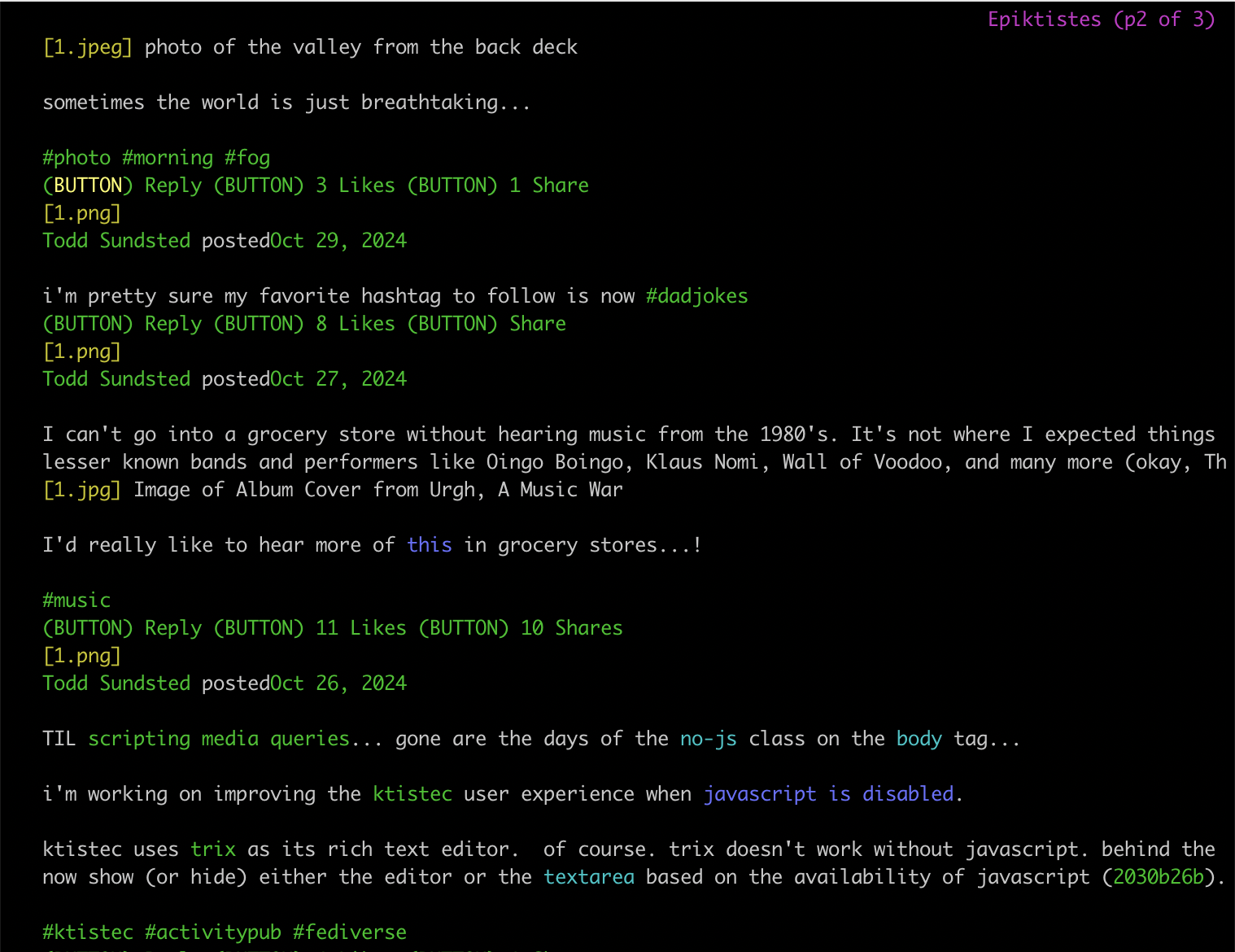
Since the early days, most controller actions supported both text/html and application/json. I cleaned up support for the latter and have officially documented the Ktistec API in the README.
In addition, I've added support for running bots/automations (prior announcement). The Ktistec server will periodically run any executable script in the etc/scripts directory. These scripts have access to the Ktistec API and can post, follow, share, like, etc. This is experimental and obviously introduces an attack surface, though that shouldn't be a problem on correctly configured hosts.
Here's the full changelog:
Added
- Support running scripted automations.
- "Fetch Once" button on hashtag and thread pages. (fixes #108)
- Support navigation to a post's threaded view. (fixes #108)
- Add support for post name and summary.
Fixed
- Improve support for operating without JavaScript available/enabled.
- Only enforce CSRF protection on "simple" requests.
Changed
- Replace use of multi-action controller with
formaction. (fixes #101)
Other
- API usability improvements.

And we have a new release: Crystal 1.14.0 🚀
Read about the highlights in https://crystal-lang.org/2024/10/09/1.14.0-released/
Happy Crystalling!
Todd Sundsted posted Sep 25, 2024
have i told you all i love spectator? i love spectator!
Todd Sundsted posted Sep 14, 2024
I just released v2.3.0 of Ktistec. It fixes a few bugs introduced in the previous release. In particular, it handles a case I've observed a few times in production where the fetching of followed content hangs. The fix adds a monitor that periodically checks for "running" tasks without a backing fiber and sets socket timeouts to ensure requests eventually terminate (I believe the latter actually fixes the problem, but belts and suspenders...)
#ktistec #crystallanguage #crystallang #activitypub #fediverse
Today we celebrate the 12th anniversary of Crystal!
The initial commit was on September 4, 2012 🎉
https://github.com/crystal-lang/crystal/commit/220bb8c736381d5beda5e7bc36c8d7f0d59badf6
Todd Sundsted posted Aug 2, 2024
I just released v2.2.0 of Ktistec. A lot of code was written but the main user-visible change is streaming timeline updates to the web client using server-sent events. The back-end pub/sub framework will also make it easier to decouple some components down the road.
I want a visual indicator that new posts are in my timeline. I appreciate that not everyone feels the same way—if there's interest I may make it switchable.
And now, off to #worldcon!
Todd Sundsted posted Jul 16, 2024
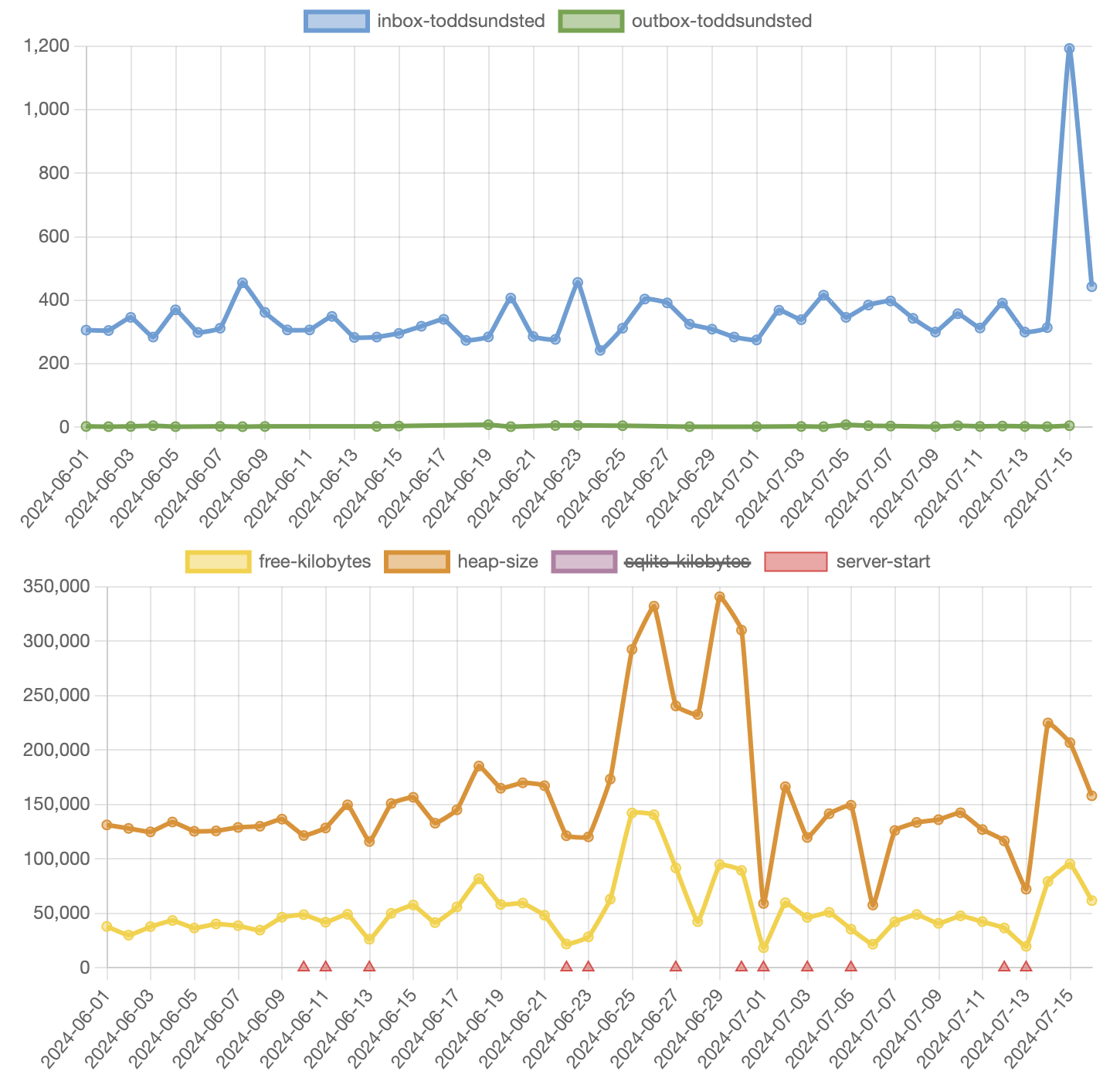
the last few days are more in line with what i expect. there is a (temporary) bump in memory, but that corresponds to a large increase in traffic.
Todd Sundsted posted Jul 9, 2024
for reasons i don't understand, some restarts of epiktistes result in huge memory usage spikes—reported both by the garbage collector and the operating system. what's interesting is heap size and free memory move roughly in tandem (though the difference isn't constant), which implies that there is free memory, but perhaps it's too fragmented to be useful?
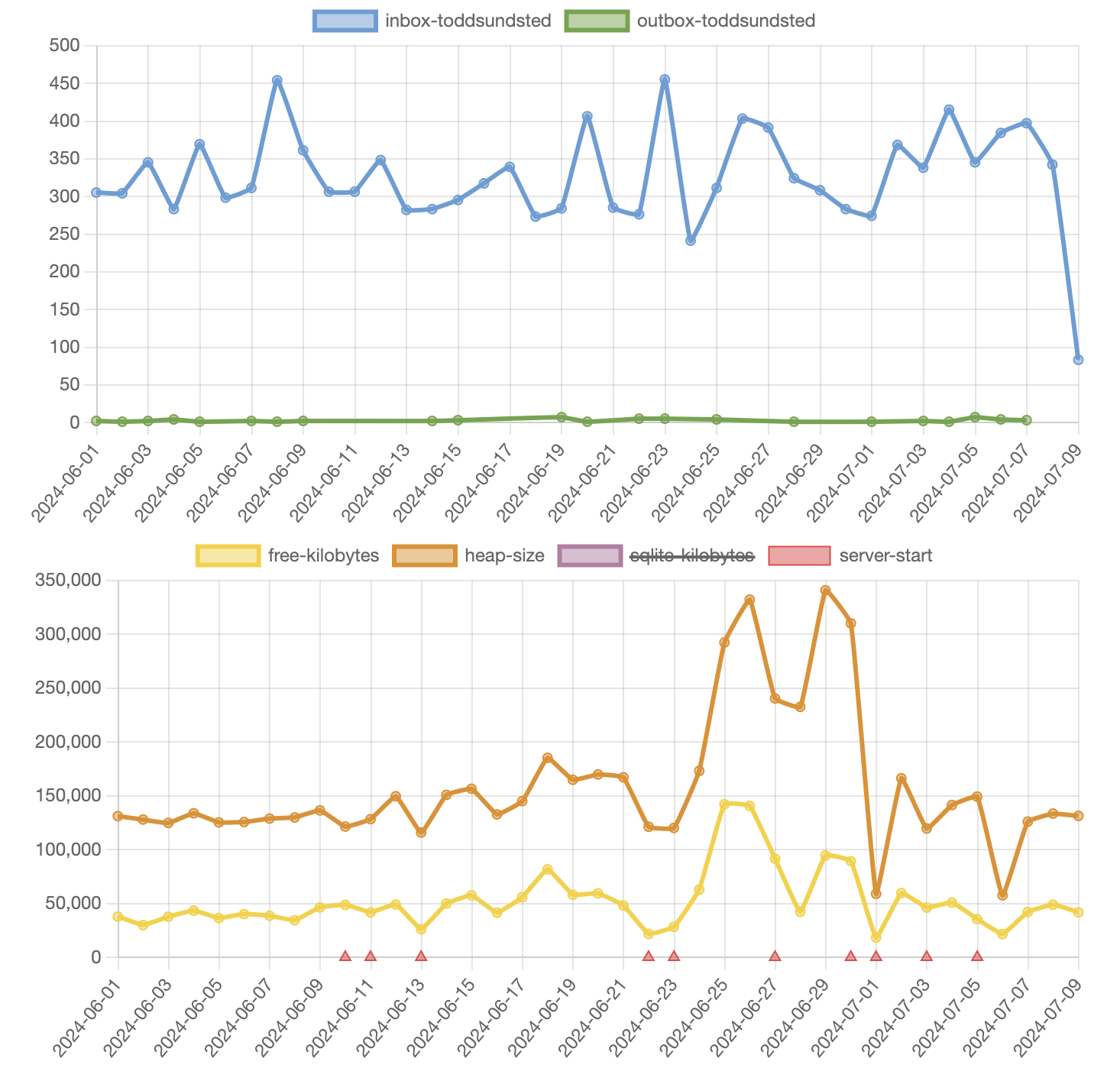
a restart typically fixes the problem...