This action will delete this post on this instance and on all federated instances, and it cannot be undone. Are you certain you want to delete this post?

Todd Sundsted
toddsundsted@epiktistes.comBetter dead than bored.
toddsundsted@epiktistes.comBetter dead than bored.
| Introduction | https://epiktistes.com/introduction |
|---|---|
| GitHub | https://github.com/toddsundsted/ktistec |
| Pronouns | he/him |
| 🌎 | Sector 001 |
Todd Sundsted posted Dec 16, 2024
when you add new functionality to old code, do you also identify and accumulate a hundred little fixme's to nearby code... or is it just me...?
do you save the changes up for a final cleanup pass or make the changes then and there? do you put each fix into its own commit?
🤔
Todd Sundsted posted Dec 11, 2024
i'm running a ~6 hour pair programming, test-driven development session for our dev team. i feel like too few organizations ever pause forward production and invest in training/practice.


Seattle 2025 Worldcon is having a sale on memberships Black Friday through Cyber Monday (November 29–December 2)!
Watch this space for the discount code, or come talk with us in person this weekend at GeekCraft Expo Seattle or find information at our fan table at Loscon 50.
Todd Sundsted posted Nov 22, 2024
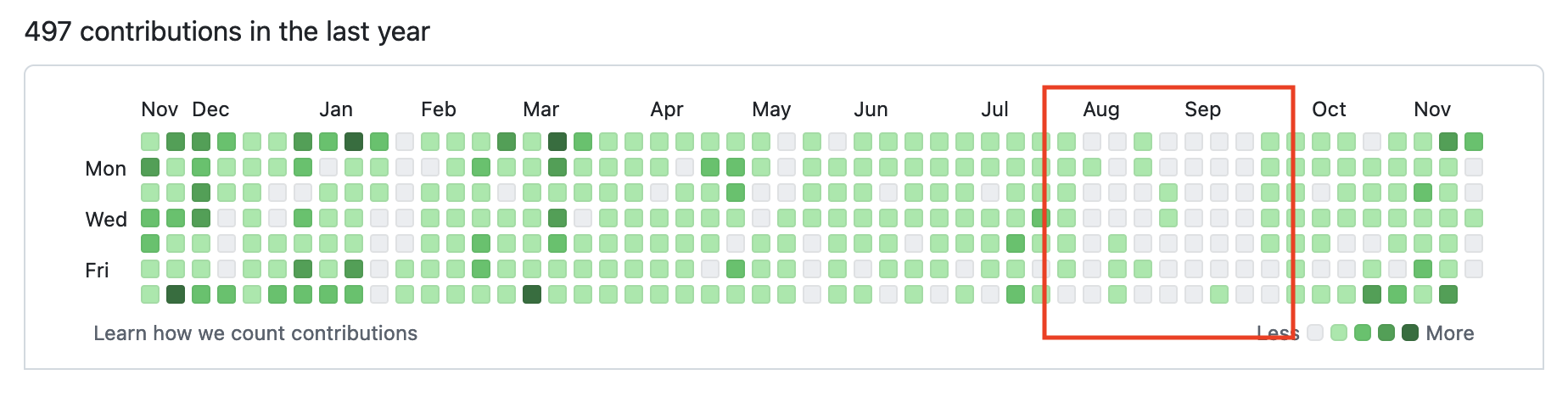
the impact of my fan/gaming convention schedule on my open source contributions this year...
Todd Sundsted posted Nov 20, 2024

when i’m back in new york, i love to browse the aisles at the strand. i picked up a used copy of revelation space by alastair reynolds for book club.
#nyc #recycling #books
Todd Sundsted posted Nov 16, 2024
Release v2.4.2 of Ktistec
Release v2.4.2 fixes a few more bugs. Only one is a regression—I found the others while testing. In this release:
Fixed
- Fix metrics chart line labels.
- Permit
del,ins, andselements in sanitized HTML. - Only store the
redirect_after_auth_pathon browser navigation. - Add "content" property to editor JSON error response.
- Use
FileUtils.mvto move uploaded files. (fixes #117)
Thanks to @jayvii for help with troubleshooting the last one!
Todd Sundsted posted Nov 14, 2024
copilots for generating awk scripts might be the sweet spot for ai...
Todd Sundsted posted Nov 12, 2024
emacsius combinatoria amnesis: when using emacs, the persistent inability to remember common keystroke combinations
Todd Sundsted posted Nov 10, 2024
Release v2.4.1 of Ktistec
Eh, I didn't test enough and released v2.4.0 of Ktistec with a few annoying regressions. Release v2.4.1 fixes them! ☹️ 😠 😡 🤬
Fixed
- Handle edge cases and race conditions in script runner.
- Reconnect editor autocomplete support.
- Fix permissions on uploaded files.
Todd Sundsted posted Nov 8, 2024
Release v2.4.0 of Ktistec
I just released v2.4.0 of Ktistec. This release encompasses a few things that I've been working on for a while: improved support for operating without JavaScript available/enabled and support for running scripted automations.
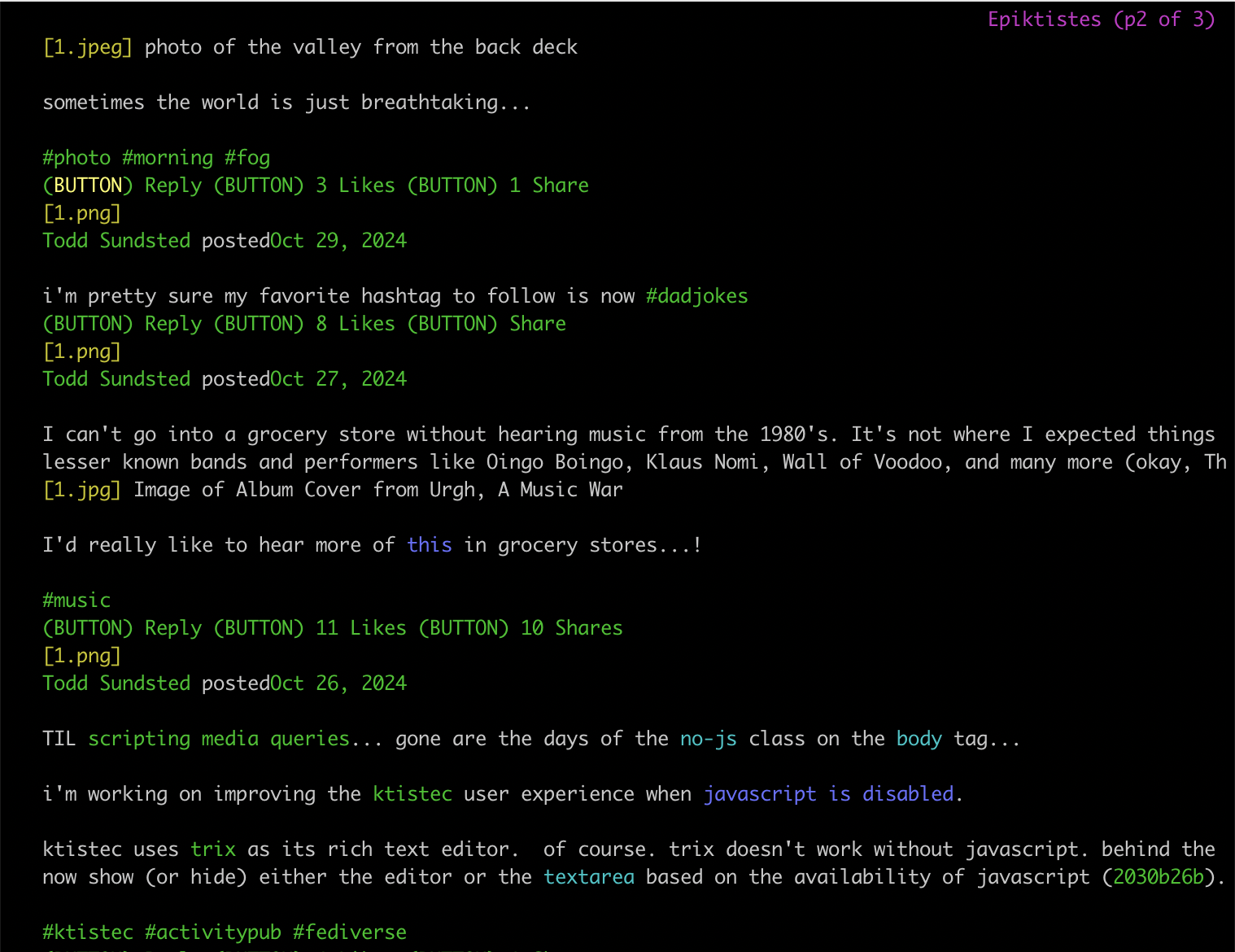
Except for a few items, Ktistec now works without JavaScript. Obviously, things like WYSIWYG editing of HTML don't work—I plan to add support for Markdown to compensate. Running in Lynx is a stretch, but...
Since the early days, most controller actions supported both text/html and application/json. I cleaned up support for the latter and have officially documented the Ktistec API in the README.
In addition, I've added support for running bots/automations (prior announcement). The Ktistec server will periodically run any executable script in the etc/scripts directory. These scripts have access to the Ktistec API and can post, follow, share, like, etc. This is experimental and obviously introduces an attack surface, though that shouldn't be a problem on correctly configured hosts.
Here's the full changelog:
Added
- Support running scripted automations.
- "Fetch Once" button on hashtag and thread pages. (fixes #108)
- Support navigation to a post's threaded view. (fixes #108)
- Add support for post name and summary.
Fixed
- Improve support for operating without JavaScript available/enabled.
- Only enforce CSRF protection on "simple" requests.
Changed
- Replace use of multi-action controller with
formaction. (fixes #101)
Other
- API usability improvements.