This action will delete this post on this instance and on all federated instances, and it cannot be undone. Are you certain you want to delete this post?
#Fediverse 71 hashtags

Todd Sundsted posted Dec 18, 2025
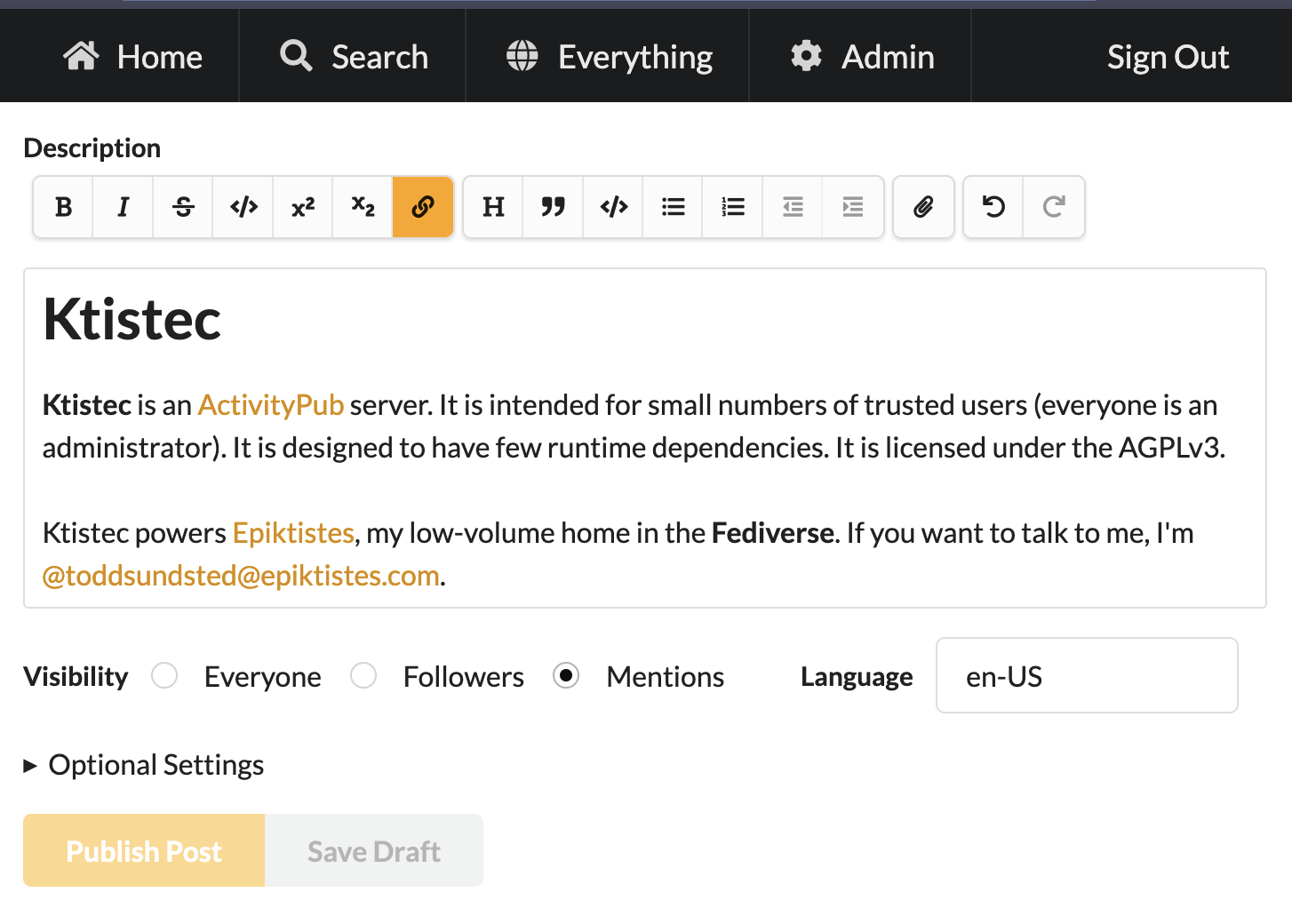
I have Markdown editing working in Ktistec!
Which post was written in Markdown?

Voilà!

This is an often requested feature. It also makes Ktistec usable in browsers when JavaScript is disabled. The Markdown editor supports autocomplete and autosave, just like the rich text editor. Expect this to show up in the next release.
Todd Sundsted posted Dec 17, 2025
Release v3.2.4 of Ktistec
The big feature in release v3.2.4 of Ktistec is support for viewing and voting on Mastodon polls (AKA FEP-9967: Polls). This feature took a surprising amount of work. Some of the effort was due to my struggles with visual design, but getting the behavior right was also tricky. For example, a "vote" is just an ActivityPub Note, but unlike other notes, it shouldn't appear in a poll's replies (it could, but that would be redundant and confusing). So I had to add exceptions throughout the code to deal with this. A custom Vote object type would have been nice in the original implementation.
Added
- Support for viewing and voting on polls. (fixes #49)
- Added tooltip to notifications menu item summarizing new notifications.
Fixed
- Improved wrapping of actor panel follow/refresh information. (fixes #130)
- Autocomplete now works correctly when adjacent to a Trix attachment.
- Image
titleattributes are now preserved.
Changed
- Moved avatars to the bottom of the object detail view.
Thank you @jayvii for the build fix!
Todd Sundsted posted Dec 10, 2025
Polls are rendering!

I'm working to get all of the little visual elements available across the Fediverse to render in a usable way on Ktistec. When released, users will also be able to vote on polls.
Todd Sundsted posted Dec 10, 2025
Release v3.2.3 of Ktistec
Release v3.2.3 of Ktistec includes two big features:
- FEP-1b12 Group federation
Improved federation with Lemmy and other forum-type servers. Ktistec supports community and thread follow/unfollow, as well as up-vote/like (down-vote/dislike is supported but there is no visual affordance for that yet). - FEP-9098 Custom emojis
Support for viewing custom emoji in posts and on actor profiles. Ktistec does not yet support custom emoji creation and management.
The full changelog:
Added
- Support for viewing custom emoji in posts and on actor profiles.
- Actor type (
Person,Group, etc.) overlay badges on actor panels. - Colored fallback avatars for actors without icons.
- Support for robots.txt.
Fixed
- Federation with Lemmy and other servers that support FEP-1b12.
- Shared inbox support for local actors.
- Serialization of
Undoincludes the undone activity. - Serialization of
LikeandDislikedoes not.
- Notify only once for an object's first received activity.
Changed
- Accumulate metrics by hour for finer granularity.
- Clean up presentation of public followers/following pages.
The next release will include support for Mastodon polls (FEP-9967).
Todd Sundsted posted Dec 7, 2025
I've improved federation support for Lemmy and other servers that support FEP-1b12 Group Federation.
I had to increase the number of available file descriptors on my personal server 4x because of the resultant inbound volume of ActivityPub activities! I liked a federated post and DOSed my server.
Todd Sundsted posted Dec 3, 2025
Release v3.2.2 of Ktistec
The big feature in release v3.2.2 of Ktistec is pinned posts with support for the Mastodon Featured Posts collection. Federation works both ways—pin a post on Ktistec and it will show up as a pinned post on Mastodon and vice versa. When you refresh an actor profile, Ktistec also fetches and updates the actor's pinned posts. This is another small step in the direction of supporting all features that Mastodon-compatible client applications expect to access via the API. It's also useful in its own right.
The other major feature, which I posted a short video demonstrating here, is X-Ray Mode. X-Ray Mode is a developer and power-user tool for inspecting ActivityPub JSON-LD representations of actors, objects, and other content. Pressing Ctrl+Shift+X on any page displays the data behind the page—like an x-ray. You can:
- Cached Version: View the local JSON-LD representation stored in the Ktistec database
- Remote Version: Fetch and view the original JSON-LD representation from the source server
- Navigation: Click on any ActivityPub IRI to navigate to that object
- History: Use
Alt+LeftandAlt+Rightto navigate through your viewing history
This feature is useful for debugging federation issues, understanding ActivityPub structures, and verifying how content is stored and represented.
Here's the full changelog for the release:
Added
- Support for pinned posts and the Mastodon "featured posts" collection.
- X-Ray Mode for viewing and navigating JSON-LD resource (actor, object, etc.) representations.
- Back links on thread pages for easier navigation. (fixes #1)
- License page for LibreJS compliance. (fixes #127)
- Highlighting of recently fetched hashtagged posts.
Changed
- Improved presentation of audio and video media.
- Refactored theming/styling implementation.
The next release will focus on smaller features and bug fixes.
Enjoy!
Todd Sundsted posted Nov 30, 2025
I've streamlined theme development in Ktistec. The theming system uses a hierarchy of CSS custom properties and fallbacks. Theme authors can customize a theme at multiple levels:
Base Colors Only
Define only base colors like --text-primary, --bg-primary, --bg-input, --semantic-primary, etc. Derived colors will auto-generate using color-mix formulas. For example:
:root { --semantic-primary: #ffa500; }From this one line, theme-appropriate colors like --bg-accent-code, --anchor-color, etc. auto-generate.
Base Colors Plus Derived Colors
Define base colors and derived colors. Derived colors use custom values when defined. Undefined derived colors auto-generate. For example:
:root {
    --text-primary: #333;
    --text-primary-2: #ff0000;  /* red for this specific shade */
}
Given this theme, derived shades like --text-primary-1, --text-primary-3, and --text-primary-4 auto-generate. --text-primary-2 is red.
The simplest possible interesting theme redefines the primary semantic color. The single line above (in Base Colors Only) would result in the following, with button color, link color, disabled, selected, and hover states all derived automatically:
These changes will be in the upcoming release. Existing themes will continue to work, as is.
Todd Sundsted posted Nov 27, 2025
Release v3.2.1 of Ktistec
Release v3.2.1 of Ktistec adds support for bookmarking posts. This was so immediately useful I don't know why it took me so long to get around to it!
Pinned/featured posts are in the works for the next release.
The full changelog:
Added
- Support for bookmarking posts.
Fixed
- Invalidate user's sessions after changing password.
- Ignore supplied languages that don't conform to expected format.
Changed
- Upgrade Kemal.
In other thoughts... I'd like to make followed hashtags more consumable. I follow ~10 hashtags and: 1) it's hard to tell what's new, 2) it feels like they arrive in large batches that are difficult to digest, and 3) the reading experience is meh.
Todd Sundsted posted Nov 13, 2025
Release v3.2.0 of Ktistec
The major feature in v3.2.0 of Ktistec is thread analysis. The previous release, v3.1.2, added support for viewing threads from Lemmy communities. I follow the Open Source community, which leads to many large threads. The thread on FFMpeg and Google has 112 posts and is still growing.
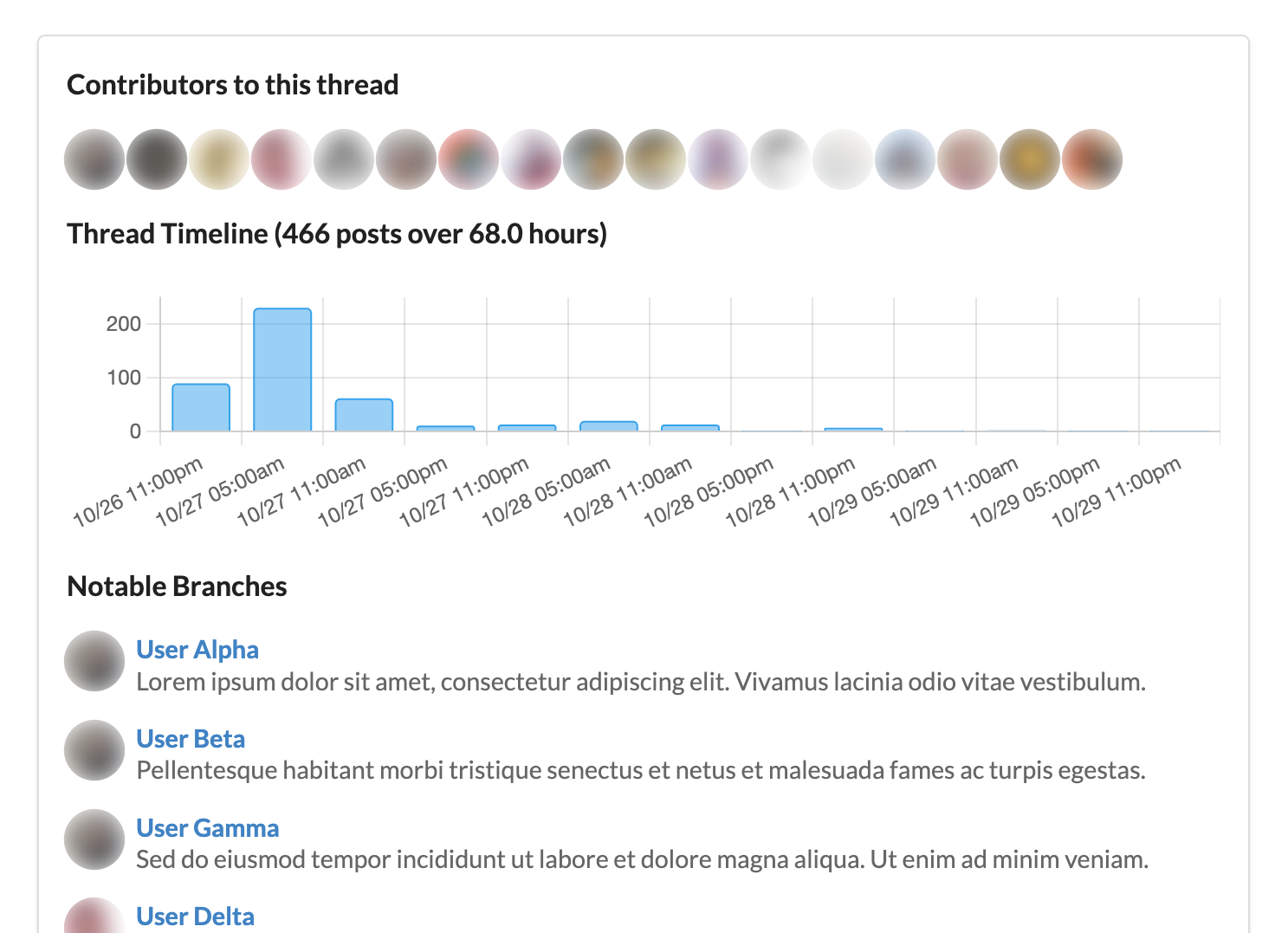
Thread analysis helps me navigate these extensive conversations. It includes: top contributors, a timeline histogram, and notable branches.
The analysis applies several heuristics to identify interesting branches of the main thread. “Interesting” is subjective, but the algorithm currently looks for sudden bursts of activity and highlights those areas. Ktistec uses this to create a table of contents that links directly to those branches. Clicking on one of these links takes you to a branch-only view that focuses on the selected part of the thread.
It's fast—I anticipated needing to cache analyses, but analyzing a thread with over 400 posts takes only about 50 milliseconds on my production server.
This release also addresses an object visibility regression that was introduced in a previous version.
Full Changelog
Added
- Thread analysis that displays key participants, a timeline histogram, and notable branches
- New MCP tools:
analyze_threadandget_thread - Focal point rendering support for image attachments
Fixed
- Regression in object visibility affecting replies to threads
Changed
- Enhanced MCP tool details for likes, dislikes, and announces
- Improved cookie security.
Todd Sundsted posted Nov 5, 2025
Release v3.1.3 of Ktistec
There are two big features in release v3.1.3 of Ktistec: auto-approve followers and a new image viewer.
Auto-approve followers is conceptually simple ("the server automatically sends an Accept activity when it receives a Follow activity") but it required extensive changes to some of the oldest code in the codebase: the inboxes and outboxes controllers. I refactored inbox and outbox side-effect processing into independent services, which made it possible to support side-effects like auto-approve follow (and also auto-follow back), without having to go through the controllers.
A more significant change for me personally was replacing the lightGallery image gallery (an external dependency) with my own implementation. It's not as slick, and not as full of features—I wrote it in two days—but it is fully free software, and that's important to me.
Added
- Add admin page for managing OAuth access tokens.
- Add support for auto-approve followers. (fixes #26)
- Add support for auto-follow back.
Fixed
- Prevent triggering actor refresh when user is anonymous.
Changed
- Replace "lightgallery" dependency with custom image viewer.
- Set OAuth access token expiry to 30 days (previously expired after 24 hours).
- Refactor inbox and outbox processing into dedicated processor services.
The OAuth changes set the groundwork for better support of the Mastodon API and the Fediverse clients that depend on it. Stay tuned!