This action will delete this post on this instance and on all federated instances, and it cannot be undone. Are you certain you want to delete this post?

Todd Sundsted
toddsundsted@epiktistes.comBetter dead than bored.
toddsundsted@epiktistes.comBetter dead than bored.
| Introduction | https://epiktistes.com/introduction |
|---|---|
| GitHub | https://github.com/toddsundsted/ktistec |
| Pronouns | he/him |
| 🌎 | Sector 001 |
Todd Sundsted posted Nov 21, 2025
commits b9e0658d to d42482bb cut the time required to run all #ktistec tests from ~35 seconds to ~26 seconds, a savings of about 25% (there are currently 5114 tests). the faster tests run, the more you run them, so this is a good outcome.
Todd Sundsted posted Nov 21, 2025
emacs comes with dunnet. i've never played it. today i am going to play it.
Todd Sundsted posted Nov 20, 2025
no #ktistec release this week. i have been working on bookmarked posts, pinned/featured posts, as well as some minor performance improvements, but i need to spend time fixing an issue with my libxml extensions that is preventing me from moving to the latest release of #crystallang. i've been putting it off but it's gotta get done, so...
Todd Sundsted posted Nov 14, 2025
My post on using emoji in Crystal Language identifiers got some 🎉 attention. The obvious question was, how much further could I take a Crystal based solution? I played around with macros for a while to see how much syntax I could replace, but that path didn't go very far. Too much of the language, like block delimiters, showed through.
It turns out there is at least one programming language designed almost entirely around emoji—Emojicode. Emojicode is pretty cool and impressively complete, but because Emojicode is, at its core, a fairly traditional imperative language, it is difficult to keep the ASCII out. 🤔
I thought I could do better by modeling an emoji-based programming language on a stack-based language like Forth. 💡 Heavy use of recursion and the stack makes it easy to avoid naming things, which means ✨ less ASCII and more emoji ✨.
This ugly duckling defines a word (a function) that computes a factorial. The factorial word is the character ❗ (the syntax 📖❗ ... 📕 defines it as a new word). You can see that ❗ calls itself recursively, right?
💭 Factorial

📖❗📚2️⃣⬇️❓👍🗑️1️⃣👎📚1️⃣➖❗✖️🔚📕

🔢5❗😀   💭 120
🔢10❗😀  💭 3628800
You can use spaces and line breaks to make things more readable, but a lot of Forth code kind of looks like this to me so 🤷.
There's already a small number of primitive words and a standard library of additional words. I'll probably play around with the core a bit more and then publish it.
Tower of Hanoi 🏯 works, too!
Todd Sundsted posted Nov 13, 2025
Release v3.2.0 of Ktistec
The major feature in v3.2.0 of Ktistec is thread analysis. The previous release, v3.1.2, added support for viewing threads from Lemmy communities. I follow the Open Source community, which leads to many large threads. The thread on FFMpeg and Google has 112 posts and is still growing.
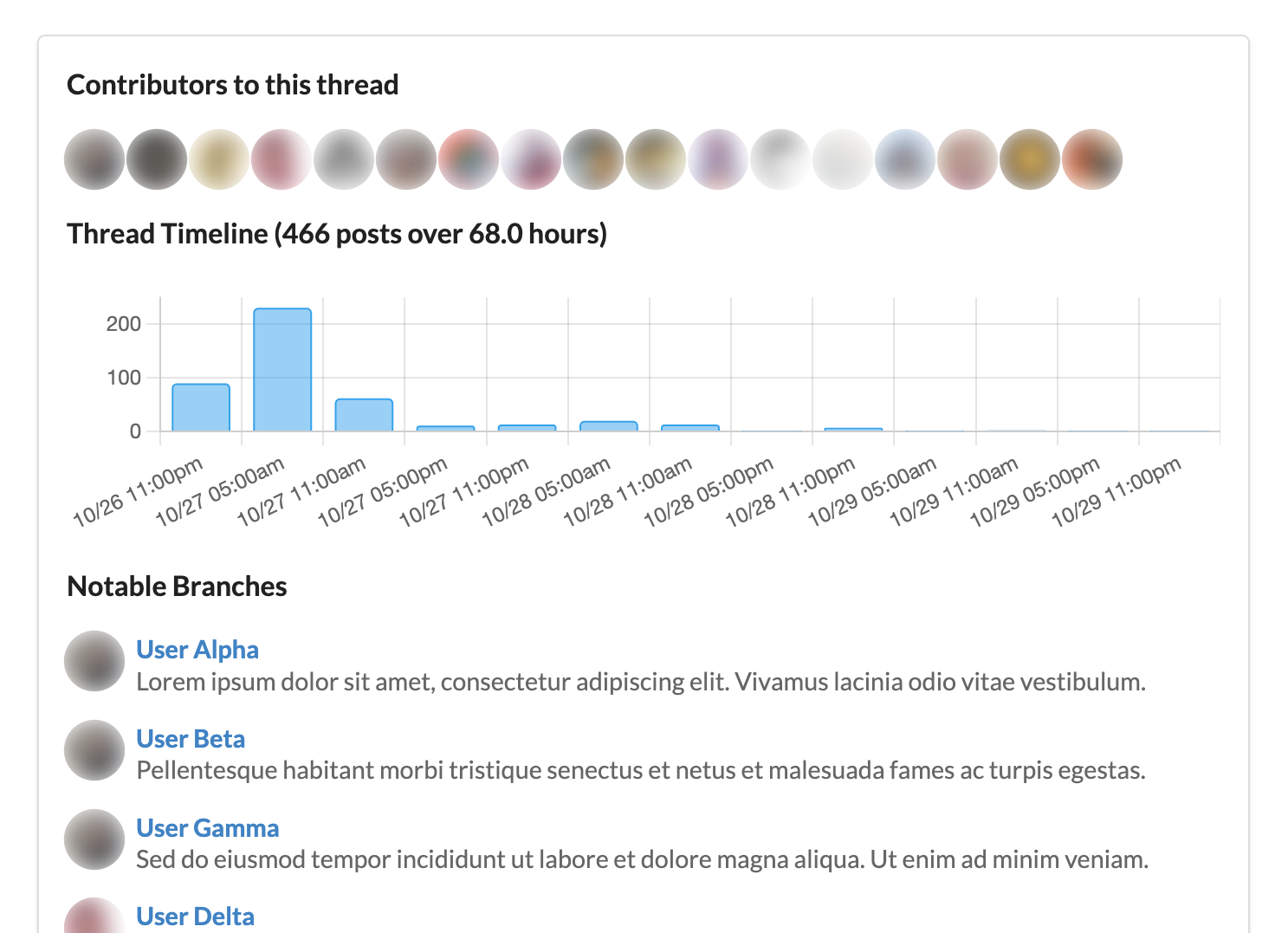
Thread analysis helps me navigate these extensive conversations. It includes: top contributors, a timeline histogram, and notable branches.
The analysis applies several heuristics to identify interesting branches of the main thread. “Interesting” is subjective, but the algorithm currently looks for sudden bursts of activity and highlights those areas. Ktistec uses this to create a table of contents that links directly to those branches. Clicking on one of these links takes you to a branch-only view that focuses on the selected part of the thread.
It's fast—I anticipated needing to cache analyses, but analyzing a thread with over 400 posts takes only about 50 milliseconds on my production server.
This release also addresses an object visibility regression that was introduced in a previous version.
Full Changelog
Added
- Thread analysis that displays key participants, a timeline histogram, and notable branches
- New MCP tools:
analyze_threadandget_thread - Focal point rendering support for image attachments
Fixed
- Regression in object visibility affecting replies to threads
Changed
- Enhanced MCP tool details for likes, dislikes, and announces
- Improved cookie security.
Todd Sundsted posted Nov 12, 2025
TIL
The … (the Unicode ellipsis character) works as both a Crystal Language macro and method name, as in:
macro …(str, n)
  Ktistec::Util.render_as_text_and_truncate({{str}}, {{n}})
end
Which can be used in a view template as:
= … preview, 120
I'm not saying you should. I'm saying you can.
Todd Sundsted posted Nov 12, 2025
the kingdom was lost for want of a path attribute in a cookie... 😡
Todd Sundsted posted Nov 11, 2025
I love a good discussion, but navigating large threads is difficult, and filtering the dross to find the silver and gold is tedious. I am working on thread analytics and an improved thread header to make it easier to identify the interesting bits and to quickly navigate to them.
Here's a peek:

In addition to top contributors, the thread header now includes a timeline histogram showing periods of engagement, and a table of contents with notable branches and direct links to those branches.
This feature is still under development, so expect changes and refinements before the next release.
Todd Sundsted posted Nov 11, 2025
Okay, my analysis is complete! Here are the core changes to Ktistec required for Mastodon API compatibility:
- PKCE (Proof Key for Code Exchange) must be optional: Because Mastodon makes PKCE optional, clients don't support it, which means other servers can't require it. PKCE (and the
code_challengeparameter) ensures that an authorization code can only be exchanged by the client that initiated the OAuth request. - Support for the
client_credentialsgrant type: Theclient_credentialsgrant type is used to grant a client app-level access without requiring user authentication. Mastodon requires this for some of its "public" API endpoints. This necessitates a change to the database schema to allow anullaccount id in the client secrets table. - Addition of a
created_attimestamp property: Mastodon requires a non-standardcreated_atproperty in the body of the/oauth/tokenendpoint response instead of (in addition to) the standardexpires_inproperty. - Support for both form-encoded and JSON request bodies: This isn't a Mastodon requirement per se but popular clients clearly demand some latitude in what they send.
- WebFinger must accept requests with no
resourceparameter: This is honestly a bug on my part. - Mastodon-compatible endpoints: A boatload of them. Clients expect many endpoints and don't gracefully degrade if they're not present. Really I should just implement features like pinned posts and bookmarks...
The only thing here that gives me heartburn is that PKCE is not required.

Physics is really bizarre and wonderful. Here I start explaining why the Standard Model has U(1) × SU(2) × SU(3) as its symmetry group. But I don't assume you know anything about groups or quantum mechanics! So I have to start at the beginning: how the electromagnetic, weak, and strong force are connected to the numbers 1, 2, and 3. It's all about quunits, qubits and qutrits.
You've heard of bits, which describe a binary alternative, like 0 and 1. You've probably heard about qubits, which are the quantum version of bits. The weak force is connected to qubits where the 2 alternatives are called "isospin up" and "isospin down". The most familiar example is the choice between a proton and a neutron. A better example is the choice between an up quark and a down quark.
The strong force is connected to qutrits - the quantum version of a choice between 3 alternatives. In physics these are whimsically called "red", "green" and "blue". Quarks come in 3 colors like this.
The electromagnetic force is connected to "quunits" - the quantum version of a choice between just one alternative. It may seem like that's no choice at all! But quantum mechanics is weird: there's just one choice, but you can still rotate that choice.
Yes, I know this stuff sounds crazy. But this is how the world actually works. I start explaining it here, and I'll keep on until it's all laid out quite precisely.