This action will delete this post on this instance and on all federated instances, and it cannot be undone. Are you certain you want to delete this post?

Todd Sundsted
toddsundsted@epiktistes.comBetter dead than bored.
toddsundsted@epiktistes.comBetter dead than bored.
| Introduction | https://epiktistes.com/introduction |
|---|---|
| GitHub | https://github.com/toddsundsted/ktistec |
| Pronouns | he/him |
| 🌎 | Sector 001 |

Shibuya Pixel Art event, tomorrow.
Impressive site: https://pixel-art.jp/spa2025
#shibuyapixelart2025

Week in Fediverse 2025-09-19
Servers
- Gush! v0.0.22
- ActivityPub for WordPress v7.4.0
- Mastodon v4.4.4
- Mitra v4.10.0
- Hollo v0.6.11
- Manyfold v0.123.0
- Ktistec v2.4.13
- Smithereen v0.11
- snac v2.83
- PieFed v1.2
- tootik v0.19.2
- kmyblue v20.0
- Wanderer v0.18.3
Clients
- Pachli v2.16.1
- Fedilab v3.35.0
- IceCubesApp v2.0.4
- Aria v1.3.10
- NeoDB You v1.0.2
- PeerTube Mobile v1.1.0
- Blorp v1.9.23
- Phanpy changelog
Tools and Plugins
For developers
- fediverse-pasture-inputs v0.3.3
- Granary v9.0
- roboherd v0.1.9
Protocol
- FEP-8967: Generating link previews for attached links
Articles
- How to Build a Simple ActivityPub Reminder Bot in Python
- Fediverse Report – #134
-----
#WeekInFediverse #Fediverse #ActivityPub
Previous edition: https://mitra.social/objects/01993fe3-2dac-3533-6a81-9e653c9d94e0
Todd Sundsted posted Sep 19, 2025
centralization always leads to the same destination. that’s why I built #ktistec and why it only supports one user*
*okay, soon to support a small number of users, but the point still stands
Todd Sundsted posted Sep 17, 2025
I think one of the strangest things about "application software development" is that an essential skill in the development process consists of taking requirements expressed in human language and manually translating them into cryptic (to most people) programming language syntax.
Of course this isn’t desirable, and we've tried so many things to change that over time: programming languages are themselves abstractions over lower-level machine language, we invented disciplines like CASE (Computer Aided Software Engineering) and methodologies like Shlaer-Mellor to assist with or automate the creation of the source code, we invented categories of products like low-code and no-code tools to change the building blocks themselves. None of that really changed the nature of application software development.
Now, we find ourselves in 2025 contemplating/confronting the literal opportunity/challenge/threat of telling a machine what we want in a human language and having them build the application. The fact that we are here surprises me. That it works at all surprises me.
That the state of the art comes down to “prompt engineering” and trying to jury-rig business requirements to satisfy an LLM does seem a little weird though.
Todd Sundsted posted Sep 17, 2025
Release v2.4.13 of Ktistec
I was planning on adding support for custom themes in release v2.4.13 of Ktistec. That turned out to be difficult, so I implemented post visibility instead—which then also turned out to be difficult. C'est la vie.
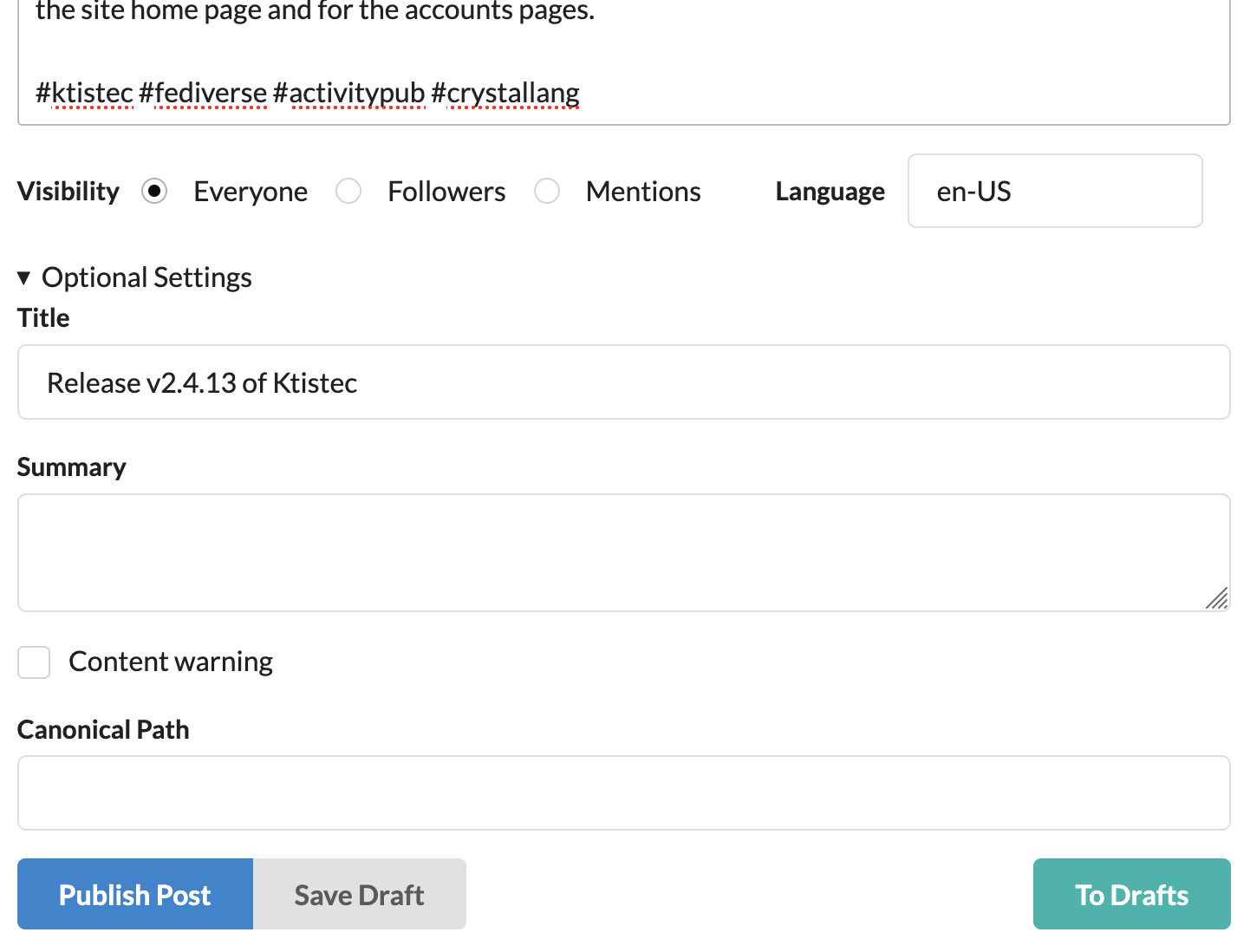
The editor now includes radio buttons for controlling post distribution and visibility. In particular, you can now send messages directly to mentioned users without sending them to all of your followers.
You can also mark posts as sensitive using the content warning checkbox in the editor. Sensitive posts are hidden behind a summary that readers can click to reveal the content.
This release of Ktistec includes RSS feeds and RSS feed discovery. RSS feeds are currently available for the site home page and account pages.
Here's the full changelog:
Added
- Support RSS feeds on the home page and account pages. (fixes #14)
- Hide sensitive content, spoilers, etc. with content warnings.
- Support direct messages with proper visibility controls.
Changed
- Switch from calendar-based periods to duration-based periods in charts.
Fixed
- Track and federate object updates.
- Fix object visibility bugs in object replies and threads.
Todd Sundsted posted Sep 15, 2025
this is a direct message for @toddsundsted (now updated)
Todd Sundsted posted Sep 14, 2025
a dependent type itself depends
on Agda, Idris, and Lean.
a list of three, on three itself
depends recursively.
Week in Fediverse 2025-09-12
Servers
- Mbin v1.8.4
- Ktistec v2.4.12
- PeerTube v7.3.0
- Lemmy v0.19.13
- gancio v1.28.0
- Misskey v2025.9.0
- NeoDB v0.12.2.1
- tootik v0.19.0
- Gush! v0.0.21
- PieFed v1.1.7
- Trunk & Tidbits, August 2025 (Mastodon)
- Introducing quote posts (Mastodon)
Clients
- IceCubesApp v2.0.0
- Mangane v1.17.2
- Aria v1.3.9
- Photon v2.0.2
- Blorp v1.9.22
For developers
- fediverse-pasture-inputs v0.3.2
- Fedialgo v1.1.38
Protocol
- FEP-11dd: Context Ownership and Inheritance
- Bite activity
Articles
-----
#WeekInFediverse #Fediverse #ActivityPub
Previous edition: https://mitra.social/objects/01991bd7-ffbb-3059-0160-12d3c53fb8aa
Todd Sundsted posted Sep 12, 2025
i’m pretty excited to have discovered @LIGO@scicomm.xyz
Todd Sundsted posted Sep 10, 2025
RSS feeds are in the works...