This action will delete this post on this instance and on all federated instances, and it cannot be undone. Are you certain you want to delete this post?
#ktistec 211 hashtags

Todd Sundsted posted Aug 21, 2025
the 113,520 lines of code across 332 files in the ktistec codebase is teaching me the importance of distinctive class/method/function/variable names
Todd Sundsted posted Aug 19, 2025
Release v3.0.0 of Ktistec
I've been running v3.0.0 of Ktistec in production for the last few weeks, and it seems stable and I’m using it every day, so it’s time to release it!
This release adds:
- Model Context Protocol (MCP) support. Ktistec can act as an MCP Server.
- OAuth2 authentication support. Ktistec can act as both an OAuth2 authentication server and a resource server.
Model Context Protocol (MCP) is a simple, general API that exposes Ktistec ActivityPub collections (timeline, notifications, likes, announces, etc.) to MCP clients. To be fully transparent about what this means, MCP clients are shells for Large Language Models (LLMs).
When building this, I focused on a few use cases that are important to me: content summarization, content prioritization (or filtering) based on my interests or the content's structure (well-constructed arguments vs. low-signal opinions) or its tone, especially when it comes to shared posts. Ktistec is a single user ActivityPub server and Epiktistes (my instance) gets a lot of traffic. I want to build the “algorithms” that surface the content I want to see.
Of note, there’s currently no support for content generation.
While I work on this, I’m not abandoning the 2.x line. I’ll continue to add compatible features and fix bugs as long as I'm able. I realize the use of LLMs, and MCP by extension, and therefore the 3.x branch, is controversial—I don’t intend to push v3 on anyone.
If you're still with me, Ktistec now exposes:
- MCP Resources
- ActivityPub actors (
ktistec://actors/{id*}) - ActivityPub objects (
ktistec://objects/{id*}) - registered users (
ktistec://users/{id}) - server information (
ktistec://information)
- ActivityPub actors (
- Tools
count_collection_since(name, since)paginate_collection(name, page, size)read_resources(uris)
- Prompts
whats_new
Supported collections include:
- timeline, notifications, posts, drafts, likes, announces, followers, following
- collections of hashtags of the form
hashtag#<name>(e.g., "hashtag#technology") - collections of mentions of the form
mention@<name>(e.g., "mention@euripides")
There is more detail in the README.
TL;DR Add a remote MCP connector in your MCP client of choice: supply the URL of your instance including the /mcp path (e.g. "https://epiktistes.com/mcp").
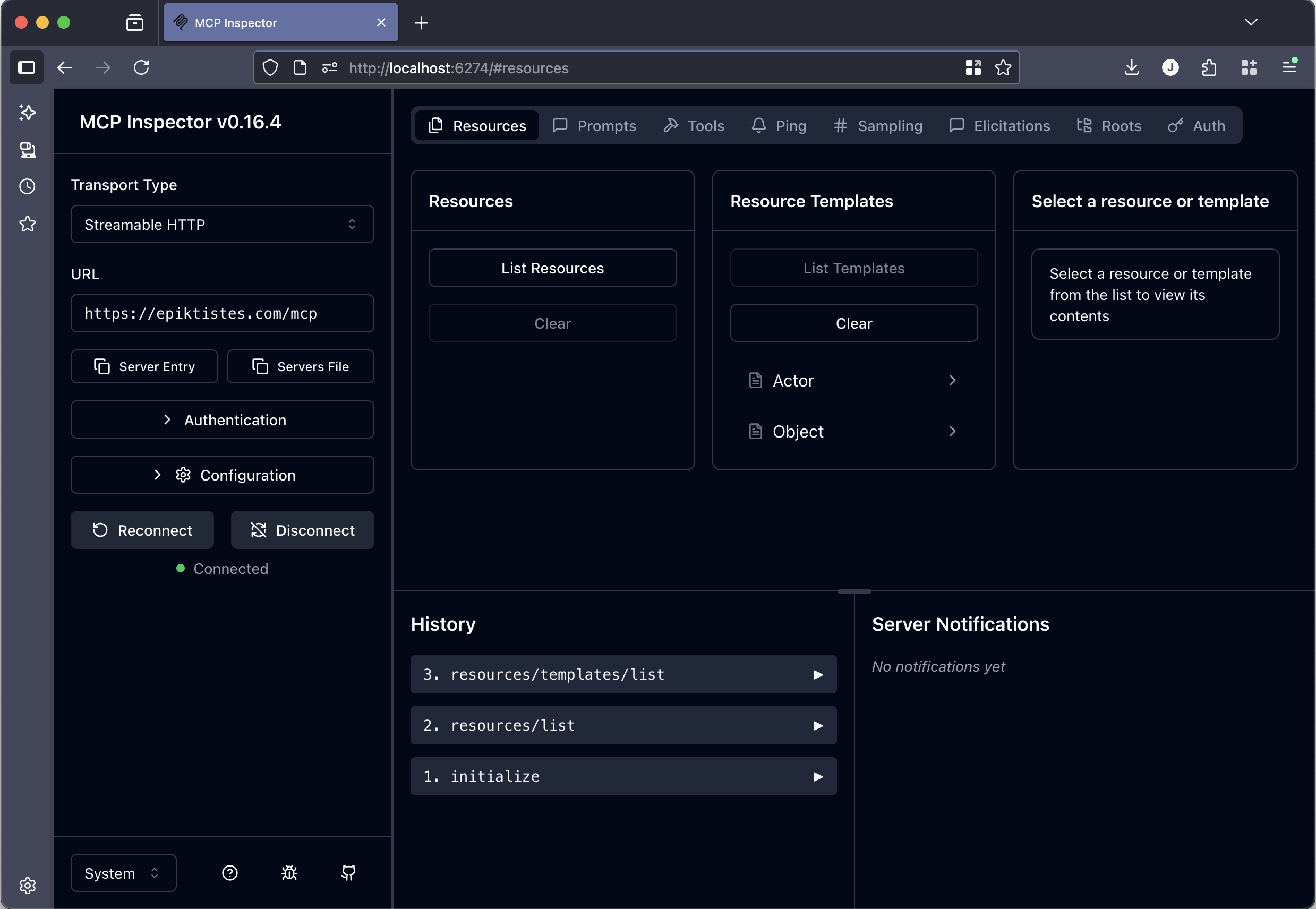
Todd Sundsted posted Aug 16, 2025
Release v2.4.9 of Ktistec
Release v2.4.9 of Ktistec fixes two significant bugs. From the changelog:
- Don't reset
next_attempt_atin tasks when server restarts. - Fix incorrect syntax for inline tags in Slang templates.
The first bug resulted in server maintenance tasks running immediately, every time the server restarted, and then beginning their cadence of scheduled runs from there. The second bug surfaced after I released a new version of Slang that itself included a bug fix.
Todd Sundsted posted Aug 6, 2025
Release v2.4.8 of Ktistec
Ktistec v2.4.8 has many small fixes and improvements, but includes one significant fix to ActivityPub garbage collection, which was the major feature introduced in the last release.
⚠️ Important Note: Building with Crystal Language version 1.17.x is not supported due to two breaking changes. See:
(Maybe it's three changes—compile times are also far slower and executable sizes are much larger.)
Added
- Send "User-Agent" header identifying Ktistec on outbound HTTP requests.
- Add accept/reject action buttons to top panel on actor pages.
Fixed
- Add index on "username" on "actors" table. (Fixes a regression introduced in e659e84a.)
- Rejection now correctly sets follow relationships as confirmed (previously they remained pending).
- Fix garbage collection issues with threads created in earlier versions.
Changed
- Prioritize the author's self-replies in thread view.
Enjoy!
Todd Sundsted posted Aug 1, 2025
Ktistec PSA
Ktistec (temporarily) only builds with versions of the Crystal Programming Language 1.16.3 and below. There was a significant change to the libxml integration in the Crystal Standard Library in version 1.17.0. Ktistec implements some extensions on top of the standard library that need to be updated as a result. A permanent fix in in progress.
Todd Sundsted posted Jul 15, 2025
Release v2.4.7 of Ktistec
After a mental health break, release v2.4.7 of Ktistec is out. The biggest improvement is the addition of a command line switch/option to run garbage collection on startup. Garbage collection, in this context, trims down your database by deleting old ActivityPub objects that are not connected to your user through:
- Attribution: Objects attributed to you or actors you follow
- Activities: Objects referenced by your activities or activities of actors you follow
- Collections: Objects in your timeline, notifications, or outbox
- Content: Objects with hashtags, mentions, or in threads you follow
It reduced the size of my database ~24%. Details on usage, warnings, etc. are in the README.
Other changes:
Fixed
- Use single quotes for string literals in SQLite queries.
- Fix
WITH RECURSIVEqueries. - Fix broken CI workflow.
Changed
- Present local internal URLs as external URLs in posts.
- Limit pagination size for unauthenticated users.
- Better convey actor/object deleted/blocked status on index pages.
- Improve presentation of inline code and code blocks.
- Clip alt text on thumbnail images.
Other
- Update cached copy of Lemmy's JSON-LD context.
Todd Sundsted posted Feb 7, 2025
Release v2.4.6 of Ktistec
Release v2.4.6 of Ktistec is out. As mentioned in an earlier post, this release focuses on database performance improvements. This means caching the results of expensive queries (like counting all posts with a particular hashtag or mention). On my instance at least, pages like the notifications page are now snappier.
There are still slow queries (queries that take more than 50msec). Most of those are requests for pages of old posts where none of the necessary database pages are in the page cache. I have increased the page cache size, and that reduces the frequency, but I don't see an immediate fix.
Fixed
- Add missing database query logging.
Changed
- Improve query performance for hashtags and mentions.
- Make less costly updates to tag statistics.
- Improve anonymous session management.
- Cache the Nodeinfo count of local posts.
Removed
- Remove support for
X-Auth-Token.
Other
- Add timeout values for
POSTsocket operations.
I don't have an immediate plan for the next release. There have been a bunch of feature requests that I think have merit. I'll probably get started on some of those.
Todd Sundsted posted Jan 31, 2025
You can specify the SQLite database and pass options (pragmas like cache_size, journal_mode, ...) on the command line when you start the Ktistec server. The following example sets the cache size to 20,000 pages (up from the default of 2,000 pages) which improves performance on larger instances.
KTISTEC_DB=~/ktistec.db\?cache_size=-20000 ./server
You can also enable the write-ahead log (but make sure you know what that means).
KTISTEC_DB=~/ktistec.db\?journal_mode=wal\&synchronous=normal ./server
Pragmas supported are limited to those listed here.
Todd Sundsted posted Jan 29, 2025
A new release of ktistec that improves database performance is imminent. In the past, database optimization usually meant "fixing a bunch of poorly constructed queries", and I'm sure there's more of that to do—I'm not an expert. But this time, I found most of the queries were as good as they were going to get on my watch (I'm not an expert). If you have a million records and you need to filter and count them, that's just going to take some time...
So this time, I focused on caching the results of queries like that (which really means I focused on cache invalidation, right). A case in point is commit d544b1af. Previously, the nodeinfo endpoint filtered and counted posts on every request, and it took +80msec to do that. Worse, the filtering pushed everything else out of the sqlite page cache, which made the next, unrelated database query slow!
Caching this value, and only recounting when I post something, not only dropped the service time for the request to ~1msec but actually improved database performance, generally!
More to come...
Todd Sundsted posted Jan 24, 2025
it's interesting to see what scans show up in the logs:
2025-01-24 16:24:11 UTC 404 GET /.env 1.16ms
2025-01-24 16:24:11 UTC 404 GET /.env 563.87µs
2025-01-24 16:24:14 UTC 404 GET /.aws/credentials 601.43µs
2025-01-24 16:24:14 UTC 404 GET /.aws/credentials 498.43µs
2025-01-24 16:24:16 UTC 404 GET /.env.example 609.78µs
2025-01-24 16:24:16 UTC 404 GET /.env.example 544.13µs
2025-01-24 16:24:18 UTC 404 GET /.env.production 798.14µs
2025-01-24 16:24:19 UTC 404 GET /admin/.env 628.06µs
2025-01-24 16:24:23 UTC 404 GET /api/.env 906.66µs
2025-01-24 16:24:25 UTC 404 GET /app/.env 574.45µs
2025-01-24 16:24:27 UTC 404 GET /app_dev.php/_profiler/open?file=app/config/parameters.yml 537.69µs
2025-01-24 16:24:33 UTC 404 GET /app_dev.php/_profiler/phpinfo 841.8µs
2025-01-24 16:24:35 UTC 404 GET /backend/.env 513.92µs
2025-01-24 16:24:36 UTC 404 GET /core/.env 661.94µs
2025-01-24 16:24:38 UTC 404 GET /credentials 649.68µs
2025-01-24 16:24:40 UTC 404 GET /crm/.env 480.42µs
2025-01-24 16:24:43 UTC 404 GET /demo/.env 579.16µs
2025-01-24 16:24:49 UTC 404 GET /info/ 614.09µs
2025-01-24 16:24:51 UTC 404 GET /infos/ 705.33µs
2025-01-24 16:24:54 UTC 404 GET /pinfo.php 489.59µs
2025-01-24 16:24:58 UTC 404 GET /vendor/.env 780.1µs
this reminds me that i have to make responding to those requests much much slower...