This action will delete this post on this instance and on all federated instances, and it cannot be undone. Are you certain you want to delete this post?
#crystallang 96 hashtags


Finally I could release Blueprint 1.0.0 after almost 2 years in development.
Todd Sundsted posted Jan 22, 2025
Crystal is fast because methods are monomorphized at compile time. In simple terms, that means that at compile time, a polymorphic method is replaced by one or more type-specific instantiations of that method. The following polymorphic code...
def plus(x, y)
  x + y
end
...is effectively replaced by two methods—one that does integer addition if called with two integers, and one that does string concatenation if called with two strings.
This extends to inherited methods, which are implicitly also passed self. You can see this in action if you dump and inspect the symbols in a compiled program:
class FooBar
  def self.foo
    puts "#{self}.foo"
  end

  def bar
    puts "#{self}.bar"
  end
end

FooBar.foo
FooBar.new.bar

class Quux < FooBar
end

Quux.foo
Quux.new.bar
Dumping the symbols, you see multiple instantiations of the methods foo and bar:
...
_*FooBar#bar:Nil
_*FooBar::foo:Nil
_*FooBar@Object::to_s<String::Builder>:Nil
_*FooBar@Reference#to_s<String::Builder>:Nil
_*FooBar@Reference::new:FooBar
_*Quux@FooBar#bar:Nil
_*Quux@FooBar::foo:Nil
_*Quux@Object::to_s<String::Builder>:Nil
_*Quux@Reference#to_s<String::Builder>:Nil
_*Quux@Reference::new:Quux
...
The optimizer in release builds is pretty good at cleaning up the obvious duplication. But during my optimization work on Ktistec, I found that a lot of duplicate code shows up anyway.
Most pernicious are weighty methods that don't depend on class or instance state (don't make explicit or implicit reference to self). As I blogged about earlier, this commit replaced calls to the inherited method map on subclasses with calls to the method map defined on the base class and reduced the executable size by ~5.8%. The code was identical and the optimizer could remove the unused duplicates.
So, as a general rule, if you intend to use inheritance, put utility code that doesn't reference the state or the methods on the class or instance in an adjacent utility class—as I eventually did with this commit.
(The full thread starts here.)
Todd Sundsted posted Jan 19, 2025
Release v2.4.5 of Ktistec
Ktistec release v2.4.5 rolls out the build time and executable size optimizations I've been blogging about here. It also fixes a few small bugs.
Fixed
- Handle @-mentions with hosts in new posts.
- Handle HEAD requests for pages with pretty URLs.
- Destroy session after running scripts.
Changed
- Delete old authenticated sessions.
I've started a branch full of query optimizations. My general rule—as highlighted in the server logs—is if a query takes longer than 50msec, it takes too long. It's time to address some problems...
Todd Sundsted posted Jan 17, 2025
The Ktistec executable is now ~24.7% smaller and build times are 28% faster.
I've been blogging about optimizations here, here, and here. This is the summary of the final outcome, with links to commits for the curious. I have one more post planned with a summary of my thoughts.
Here's my approach. Use nm to dump the symbols in a release build executable and then look for things that seem redundant. The first change and associated post below is a great example of what I mean—my original implementation led to the specialization of the #== method for every pairwise combination of model classes even though the result of the comparison was just false.
This might seem like a strange approach if you come from a compiled language where you mostly write all of the code yourself or invoke generics explicitly, but Crystal takes your code and does that for you. And it's not always obvious up front (to me, at least) what the final cost will be.
I've include counts of the lines added/removed because the point of this whole post is to say if you measure first and then optimize, a small change can have a big impact.
Here are the changes:
- Specialize model
#==. (+7 -5)
I talked about this here but didn't have the commit to link to. This change results in a large reduction in executable size on regular builds (~4.0%) and a small difference on release builds (~0.2%). - Remove conversion to
Hash. (+2 -2)
This commit eliminates specialization of methods like__for_internal_use_onlythat get passed both named tuples and hashes by going all in with named tuples. It also eliminates instantiations of theHashgeneric type itself for these cases. Reduces executable size by ~2.2%. - Eliminate duplicate code in the executable. (+3 -3)
This small change reduces the size of the executable by a further ~0.4% by eliminating redundant definitions of__for_internal_use_onlyentirely. - Make
InstanceMethodsinstance methods. (+1 -5)
This was a goofy design I picked up somewhere. It's unnecessary. Changing this saves ~0.2% on release build executable size. - Move the code for digging through JSON-LD. (+246 -281)
It looks like a lot of lines of code changed here, but the large numbers are the result of moving code line-by-line from an included module to a utility class. Invoking these as methods on the utility class rather than as instance methods on each including class reduces the executable size by ~0.5%. - Use
mapfrom base ActivityPub model classes. (+10 -2)mapis a class method defined on each ActivityPub base model class. Each definition maps JSON-LD to a hash that is used to instantiate the class. Class methods defined on a base class are available on subclasses, as well. Calling the method on the subclass results in a copy of the method. This change reduces the executable size by ~5.8%. - Move
mapinto helper. (+104 -88)
Themapmethod does not depend on class/instance state. This change ensures that the mapping code is not duplicated even if a subclass'smapmethod is accidentally again called. It looks like a lot of changes but this commit is mostly reorganization. It reduces executable size by ~0.4%. - Replace classes with aliases. (+62 -148)
Implementing ActivityPub's vocabulary with discrete model classes is expensive because every model class comes with machinery for type-specific CRUD operations. Enumerate aliases on each base model class (e.g. a "Service" is an "Actor"). This change reduces executable size by ~16.9%.
I'm off to optimize some queries now...

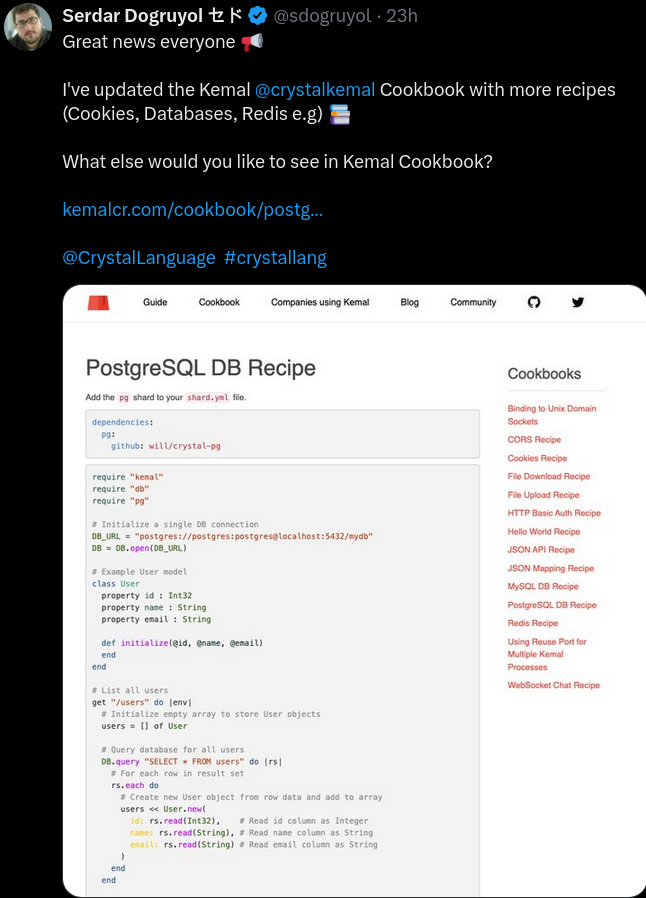
Serdar updated the #crystalkemal cookbook with more recipes (i.e. #Cookies, #Databases, #redis ).
If you're looking for a #sinatra like framework for @CrystalLanguage, then #kemalcr is the best way to go.
#CrystalLang #CrystalLanguage#kemal

Migrated a simple API endpoint from #Rails to #Crystal (#CrystalLang) using the #Marten web framework. It’s incredible to see a web application running on just 2MB of memory—hard to imagine that’s even possible!
PS: Congratulations on the release of Crystal 1.15!
Todd Sundsted posted Jan 9, 2025
The prologue to this post, and other posts in the series, is here.
Investigating commit b65d292f was fruitful but not for obvious reasons.
Dumping the symbols (nm -j server) before and after the commit showed large number of new equality (==) methods. From the diff:
1765a1772
> _*ActivityPub::Activity::Accept#==<Translation>:Bool
1920a1928
> _*ActivityPub::Activity::Add#==<Translation>:Bool
2062a2071
> _*ActivityPub::Activity::Announce#==<Translation>:Bool
2237a2247
> _*ActivityPub::Activity::Block#==<Translation>:Bool
    ...
The use, in a controller action, of the new Translation model seemingly triggered their generation. What was going on?
A long time ago I implemented a MVC model framework in the style of ActiveRecord (2de4a4b3) and it included a method for testing for equality. Note the method signature.
# Returns true if all properties are equal.
#
def ==(other : self)
  {% begin %}
    {% vs = @type.instance_vars.select(&.annotation(Persistent)) %}
    if
      {% for v in vs %}
        self.{{v}} == other.{{v}} &&
      {% end %}
      self.id == other.id
      true
    else
      false
    end
  {% end %}
end
The Reference class—the default parent for classes—defines two base implementations of this method: one that tests for identity (not equality), with the signature def ==(other : self), and another that returns false, with the signature def ==(other). When I implemented my method, my assumption was: redefine the former for model classes and let the latter take care of everything else. This assumption was incorrect.
In circumstances that I still don't completely understand, the compiler will generate calls to the latter (the method that just returned false) when it "should have" been calling the former, and comparisons failed when they should have succeeded. I "fixed this" with commit effeaa26 that removed the type restriction and explicitly handled the type check. Everything worked!
The problem is Crystal creates a version of this method for every possible model comparison, specialized by both self and other. Most of the time the type check fails and the method returns false. But the rest of the code is still present.
The fix (re)adds a method specialization that returns false and lets the compiler handle the type check.
# Returns `false`.
#
def ==(other)
  false
end
Because this method just returns a constant value, the compiler gets rid of the method call, as well.
Interestingly, this change reduced the size of the Ktistec server executable by 4.0% when building without the --release flag but only 0.2% when building with it, so optimization does a good job at cleaning this up even without the change.
Todd Sundsted posted Jan 7, 2025
what's the union of all errors that a call like HTTP::Client.get(...) (in Crystal) might raise?
i typically rescue IO::Error (which gets hostname lookup and socket connection problems), OpenSSL::Error (which gets a few edge-case problems with SSL configuration on the other end), Compress::Deflate::Error and Compress::Gzip::Error (which gets a few even more edge-case configuration problems on the other end), and URI::Error.
what am i missing?
Todd Sundsted posted Jan 5, 2025
Release v2.4.4 of Ktistec
Ktistec release v2.4.4 fixes a few things in the prior release and introduces at least one killer feature!
Fixed
- Always get the attachments. (fixes #119)
- Don't run scripts until the server has been configured.
Changed
- ⭐️ Make the editor toolbar sticky.
- Clear the cached translator when the settings change.
I'm spending some cycles looking at the size of the server executable. You can read about my approach to reducing Crystal Language executable size and build time here.
Todd Sundsted posted Jan 4, 2025
The prologue to this post is here.
Investigating commit e2327eea might be a bust.
I dumped the symbols before and after this change. The new symbols were all specializations of the core library Hash class introduced by adding JSON parsing support for the "language" property.
So what does that mean and why is this commit a dead end?
You can think of Crystal classes and methods as being implicitly generics. If you have a method foo with one parameter bar and call it with an Array, Crystal creates a version of that method specialized to handle an Array type as an argument. If you call it with a Hash, Crystal creates another version of that method specialized to handle a Hash type as an argument. If the method has 20 lines of code, you effectively get two copies of those 20 lines of code. There is no runtime polymorphic dispatch, which is one of the reasons Crystal is so fast. You can make all of this explicit with Crystal type restrictions, method overloading, and generics, of course, but you don't have to.
This path is a dead end (for now) because any improvements that I can see that I can make (replacing hash construction with a more fluent sequence of attribute assignments) will need to be made to other classes where this is a problem, and there are only a few of those, so the net potential for improvement seems small.