This action will delete this post on this instance and on all federated instances, and it cannot be undone. Are you certain you want to delete this post?
#crystallang 85 hashtags

Todd Sundsted posted Oct 21, 2025
Release v3.1.0 of Ktistec
This release of Ktistec merges the main_3.x branch into the main branch.
Managing two branches, and two releases, was a lot of work. And sometimes changes were lost in the shuffle, like:
Added
- Add a small banner to highlight "offline" status.
- Support YAML MCP prompts and hot-reloading.
I have about a dozen more features and fixes that are ready for the next release, but to keep things simple, I'm doing the merge first, in its own commit.
Todd Sundsted posted Oct 3, 2025
Release v2.4.16 of Ktistec
Release v2.4.16 of Ktistec... because I forgot to include some critical code in v2.4.15... namely, the menu.
Changed
- Reorganize the admin menu.
If you're not planning on adding additional users, you don't need to update!
Todd Sundsted posted Oct 2, 2025
Release v2.4.15 of Ktistec
Experimental support for multiple users landed with Ktistec release v2.4.15. "Experimental" means that it works for me, but hasn't seen enough testing for me to call it "ready for production". With that said, it's unlikely you'll lose your data.
There are lots of intentional design decisions that fit my vision for Ktistec but may surprise you. Here they are:
Every user is an administrator. That doesn't mean users have access to each other's posts and data, but it does mean all users have access to the shared parts of the site—they can change the site description, for example—and they can add new users. So only add people you trust.
If you want to add another user, create an account for them and give them their username and password. There is no self-registration. There are no invitations.
Beyond adding a user, there is no support for user management. You can't even boot a user from your site. Users can delete themselves, however.
There is no support for content moderation. Only add people you trust.
TL;DR Multi-user support in Ktistec is suitable for small teams, families (biological or chosen), and your personal avatars. There are better tools for online communities.
Here's the full set of changes:
Added
- Add support for multiple user accounts.
Fixed
- Hide attachments behind the summary. (fixes #125)
- Mark actors as up after refreshing their profile.
Todd Sundsted posted Sep 27, 2025
Todd Sundsted posted Sep 24, 2025
Release v2.4.14 of Ktistec
Release v2.4.14 of Ktistec is small in terms of features and fixes, but it improves in two areas where I thought Ktistec was weak: light/dark mode support and autosave.
I'm not hardcore dark mode, but I do prefer it in some cases. Ktistec selects light or dark mode based on the browser or system setting—there is currently no means to select the mode directly. A nice side effect of light/dark mode support is that custom theming support comes nearly for free.
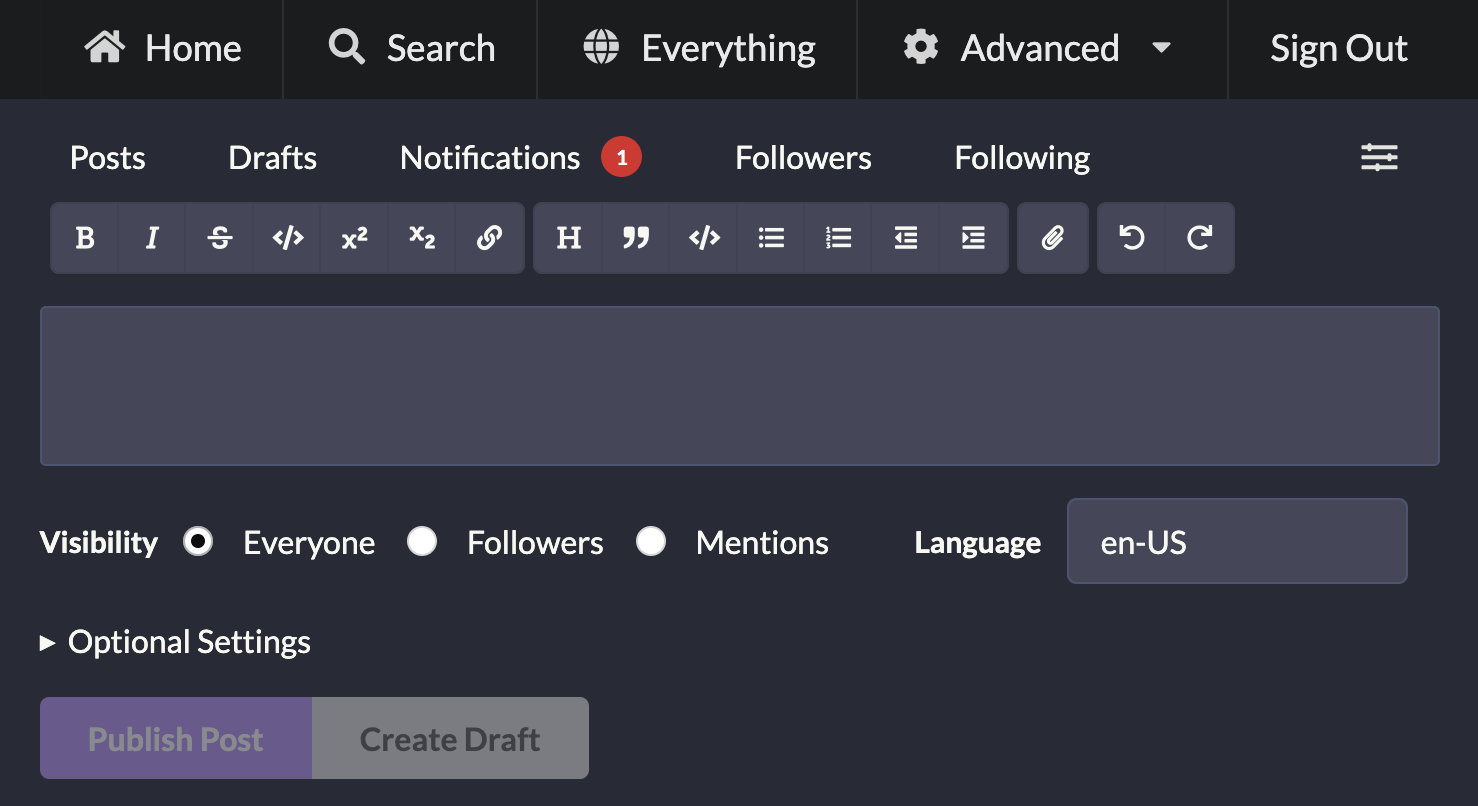
Ktistec was meant for writing. I post my fair share of one-line bits of wisdom, but I started building Ktistec because I wanted a space to write long form, and existing Fediverse platforms were more for social interaction. When writing long form, autosaving is an essential feature. Ktistec will now autosave draft posts and replies. If you navigate away before publishing, you can always find the incomplete draft in the Drafts collection which is accessible from your timeline page.
Added
- Add design system page for previewing UI elements.
- Support custom themes with automatic light/dark mode switching.
- Add autosave functionality for new posts, draft posts, and replies.
Changed
- Add external link indicators.
Todd Sundsted posted Sep 17, 2025
Release v2.4.13 of Ktistec
I was planning on adding support for custom themes in release v2.4.13 of Ktistec. That turned out to be difficult, so I implemented post visibility instead—which then also turned out to be difficult. C'est la vie.
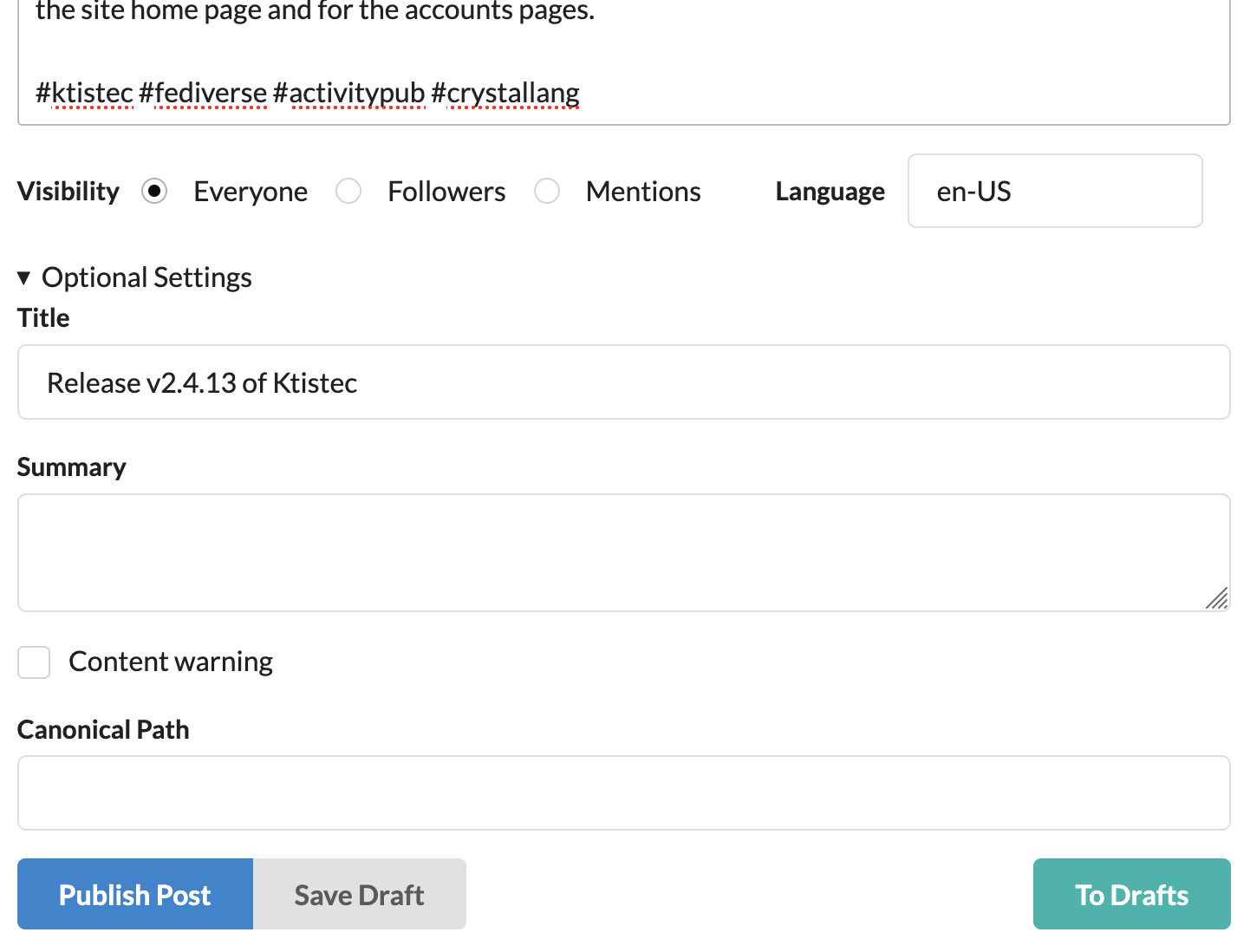
The editor now includes radio buttons for controlling post distribution and visibility. In particular, you can now send messages directly to mentioned users without sending them to all of your followers.
You can also mark posts as sensitive using the content warning checkbox in the editor. Sensitive posts are hidden behind a summary that readers can click to reveal the content.
This release of Ktistec includes RSS feeds and RSS feed discovery. RSS feeds are currently available for the site home page and account pages.
Here's the full changelog:
Added
- Support RSS feeds on the home page and account pages. (fixes #14)
- Hide sensitive content, spoilers, etc. with content warnings.
- Support direct messages with proper visibility controls.
Changed
- Switch from calendar-based periods to duration-based periods in charts.
Fixed
- Track and federate object updates.
- Fix object visibility bugs in object replies and threads.
Todd Sundsted posted Sep 8, 2025
Release v2.4.12 of Ktistec
The biggest changes in release v2.4.12 of Ktistec are the UI/UX enhancements. The mobile profile, in particular, felt like an afterthought—which it was. The changes make the mobile experience much more pleasant and ergonomic. All of the credit for this work goes to @jayvii.
This release also now refuses to deserialize and use embedded ActivityPub objects from hosts other than the host of the embedding object. While I haven't encountered any problems with the previous implementation in practice, this fix closes a gap that could be exploited by a bad actor to spoof or change content.
Added
- Add follow request status to the actor panel.
- Compute and cache monthly active accounts.
Changed
- (Internal) Only consider properties with changed values as "changed".
- (Internal) Only deserialize embedded ActivityPub objects if hosts match.
Fixed
- Remove line breaks in Turbo Stream output.
Todd Sundsted posted Aug 29, 2025
Release v2.4.11 of Ktistec
Ktistec is taking steps toward supporting multiple users. The first (small) step removes the actor panel from the unauthenticated home page and replaces it with a site description. You can see this in action at epiktistes.com. The site description is managed on the settings page using the same rich text editor used to edit posts. See the README for more information.
Other changes in this release:
Added
- Support a "site description" on the unauthenticated home page.
- Support autofocus on onboarding and authentication forms.
- Add
trix_editorview helper.
Changed
- Remove accounts from unauthenticated home page.
- Persist timeline filters in session.
Fixed
- Exclude abstract classes from
all_typesoutput. (fixes #104) - Work around bug in
at_beginning_of_week. (see crystal-lang/crystal#16112)
Other
- Disable streaming updates on pages other than the first. (fixes #118)
- Pin Crystal version at 1.16.3 in Docker build. (see libxml_ext#1)
Todd Sundsted posted Aug 23, 2025
Release v2.4.10 of Ktistec
I'm trying to get through the backlog of bugs and features in my to-do list. Release v2.4.10 of Ktistec packages up several important improvements. The most impactful change is graceful server shutdown—I've never had a problem with shutdown leaving the database in a broken state, but prevention is the best cure.
Added
- Support manually refreshing actor information. (fixes #112)
- Add link to log level settings to the navigation bar.
Fixed
- Enable dragging source links to the address bar. (fixes #109)
- Fix missing reply/mention notifications for non-create activities.
- Ensure the network is up before attempting to refresh a page.
Changed
- Block actor handle and display name when actor or post is blocked.
- Gracefully shut down the server.
I'm considering adding lightweight multi-user support (invitation-only, not open registration). I'm interested in your thoughts on whether this would be useful.
Todd Sundsted posted Aug 21, 2025
the 113,520 lines of code across 332 files in the ktistec codebase is teaching me the importance of distinctive class/method/function/variable names